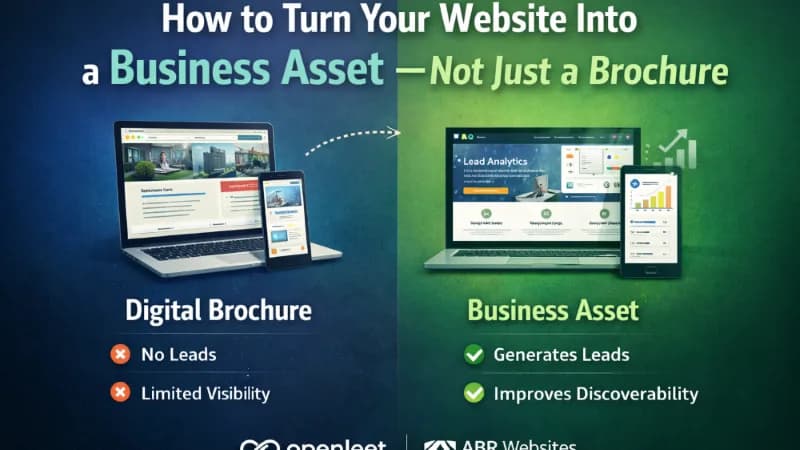
Most small business websites function like digital brochures.
They show:
A logo
A short description
A phone number
A few photos
And that’s it.
But in 2026, that’s not enough.
A modern website should function as a business asset — something that:
Generates leads
Structures your services
Improves discoverability
Supports AI search
Builds long-term equity
Let’s break down how to make that shift.
1️⃣ Define a Clear Positioning Statement
A brochure says:
“We offer quality services.”
A business asset says:
“We help Squamish homeowners restore hardwood floors in 48 hours.”
Specific positioning:
Increases conversions
Improves search clarity
Strengthens local signals
If your headline is vague, your visibility and conversions suffer.
2️⃣ Structure Your Services (Not Just List Them)
Most websites list services in a paragraph.
Instead, treat each service as its own structured entity:
Clear service name
Detailed description
Benefits
Pricing guidance
FAQ
Call-to-action
When services are properly structured, search engines and AI systems understand them better.
Platforms like Openleet allow structured service modeling automatically — turning generic content into organized business data.
3️⃣ Add a Strategic FAQ Section
FAQ sections are powerful for three reasons:
They answer objections
They improve SEO
They support AI discoverability
Examples:
How long does your service take?
What areas do you serve?
What does pricing depend on?
Do you offer emergency support?
Each question adds search intent coverage.
Without FAQ, you’re missing valuable opportunity.
4️⃣ Make Your Website Location-Specific
A brochure says:
“We serve everywhere.”
A business asset says:
“We serve Squamish, Whistler, and North Vancouver.”
Specific locations improve:
Local SEO
Map visibility
Trust
Conversion rates
Generic geography reduces authority.
5️⃣ Add Clear Conversion Pathways
Every page should answer:
What should the visitor do next?
Call?
Book?
Request a quote?
Start online?
Clear CTAs increase action.
A website without a call-to-action is just information — not an asset.
6️⃣ Implement Structured Data
This is where most websites fail.
Structured data helps search engines and AI systems understand:
What services you offer
What products you sell
Your location
Your pricing
Your FAQs
Your business type
Without structured data, your website is harder to interpret.
Openleet automatically organizes business data into structured formats.
Professional optimization can further enhance this modeling for competitive markets.
7️⃣ Track and Refine Performance
A brochure is static.
A business asset evolves.
Monitor:
Which pages attract traffic
Which services get clicks
Which FAQs are read
Where visitors drop off
Optimization turns traffic into growth.
8️⃣ Build Internal Authority
A real business asset includes:
Articles
Guides
Service breakdowns
Educational content
Content builds trust.
Trust builds conversions.
Authority builds long-term value.
The Shift in Mindset
A brochure mindset asks:
“Does my website look nice?”
An asset mindset asks:
“Is my website working for me?”
Is it:
Bringing inquiries?
Improving visibility?
Structuring my business?
Supporting long-term growth?
If not, it’s underperforming.
The Hybrid Approach
Many businesses now:
Launch on a structured platform.
Get their services organized.
Add FAQ and local targeting.
Upgrade with professional optimization when needed.
This approach balances:
Speed
Budget
Long-term scalability
Final Thought
Your website should not just represent your business.
It should actively support it.
If your current website is just displaying information,
you may be missing opportunities for visibility, lead generation, and growth.
Structure creates clarity.
Clarity creates discoverability.
Discoverability creates revenue.