Openleet Booking: A Booking System Built Around How Service Businesses Actually Work
Online booking should be more than a calendar with a few available time slots.
For a service business, every appointment is a commitment. The business must provide the right service, at a workable time, in the correct location, with the necessary staff, equipment, and customer information available.
Openleet Booking is designed around this reality.
It connects services, business hours, staff and resources, service areas, customer questions, appointment communication, and scheduling rules in one system. Customers receive a clear and convenient booking experience, while business owners retain control over when and how appointments are accepted.
What is Openleet Booking?
Openleet Booking is an appointment-management system integrated into the Openleet business platform.
Instead of requiring a business to send customers to a separate scheduling product, the booking experience can remain connected to the business’s website, services, contact information, and public presence.
A business can use Openleet to:
Define bookable services
Publish accurate availability
Set service durations and scheduling buffers
Manage staff, rooms, vehicles, and other resources
Configure service areas using postal codes
Collect information before an appointment
Automatically or manually confirm requests
Send booking notifications and reminders
Allow customers to cancel or reschedule when permitted
Manage appointments and customer history from the dashboard
Subscribe to a private appointment calendar feed
The result is a booking system that reflects how the business actually operates—not merely when its calendar appears empty.
A booking journey connected to the business
Customers often need context before they are ready to make an appointment. They may want to understand what a service includes, where it is available, how long it takes, and whether it is suitable for their needs.
Openleet keeps that information connected.
A customer can learn about the business and its services, then move into the booking process without being sent into an unrelated third-party experience. This creates a more consistent journey and helps the customer understand exactly what they are requesting.
It also reduces duplication for the business owner. The service being booked is based on information the business has already defined and controls.
Service-specific scheduling rules
Different services rarely follow identical scheduling rules.
A consultation may take 30 minutes, while an installation could require several hours. One service may happen online, another at the business location, and another at the customer’s address.
Openleet allows each service to have its own operational settings, including:
Service name and description
Appointment duration
Buffer time before and after the appointment
Maximum simultaneous capacity
Minimum booking notice
Maximum advance-booking period
Location type
Price label
Automatic or manual confirmation
Available days and hours
Eligible staff and resources
Supported service regions
Service-specific customer questions
These controls make availability more realistic. Customers are shown times that fit the requirements of the selected service rather than a generic business calendar.
Live availability based on real constraints
Openleet calculates availability using the rules configured by the business.
The system can consider:
Normal weekly business hours
Service-specific schedules
Appointment duration
Preparation and travel buffers
Existing appointments
Simultaneous capacity
Assigned resources
Scheduled closures
Minimum notice requirements
Advance-booking limits
Service-region schedules
Regional travel rules
This helps prevent unavailable or impractical times from being presented to customers.
The purpose is not simply to fill a calendar. It is to offer appointment times the business can realistically deliver.
Opening hours, closures, and schedule exceptions
Regular business hours provide the foundation for availability. Business owners can define their timezone, working days, operating hours, and the intervals at which appointment start times appear.
Real schedules also include exceptions.
Openleet allows businesses to block periods for:
Holidays
Vacations
Training
Staff events
Maintenance
Private commitments
Full-day closures
Partial-day closures
These blocked periods prevent new appointments from being scheduled during unavailable times without automatically canceling existing appointments.
Staff and resource management
Availability may depend on more than time.
A service could require a particular team member, treatment room, vehicle, workstation, or piece of equipment. If that resource is already in use, accepting another appointment may be impossible even when the general calendar appears open.
Openleet allows businesses to create and manage resources such as:
Employees
Contractors
Teams
Rooms
Vehicles
Equipment
Specialized work areas
Resources can be assigned to the services that require them. Capacity rules help protect those resources from being overbooked.
This is especially valuable for businesses where several services share the same limited people or equipment.
Service areas and postal-code validation
Mobile and on-location businesses face scheduling challenges that ordinary appointment calendars do not address.
A cleaner, repair technician, photographer, mobile wellness provider, or home-service company cannot always serve every location at every time. Travel distance and regional schedules affect what is realistically available.
Openleet supports service regions that can be defined using:
Postal codes
Postal-code prefixes
Region names
Region-specific days and hours
Travel-buffer time
Services available within each region
When required, customers enter their postal code before selecting an appointment. Openleet can then determine whether the address is within the business’s coverage area and show availability appropriate to that region.
This helps businesses avoid receiving requests from locations they do not serve.
Smarter routing for mobile services
Openleet’s regional scheduling can also support businesses that organize work by geographic area.
For example, a business may serve one part of a city in the morning and another part in the afternoon. It may dedicate certain days to particular communities or avoid switching repeatedly between distant regions.
Regional route rules help the business reserve practical blocks of time and reduce unnecessary travel.
The operational benefits can include:
Less travel between appointments
Lower transportation costs
More predictable arrival times
Better use of staff hours
More appointments within the same area
A schedule that is easier to manage
This makes Openleet particularly useful for businesses that deliver services at customer locations.
A configurable customer journey
Not every business needs the same booking form.
Openleet allows the booking journey to be configured around the information each business requires. Available steps can include:
Service selection
Contact information
Customer address
Date and time
Additional questions
Review and confirmation
Businesses can decide which steps are enabled and which information is required.
This keeps simple bookings straightforward while allowing more complex services to collect the necessary details before the business accepts the appointment.
Custom booking questions
The information needed before an appointment varies by business and service.
A consultant may need to understand the customer’s goals. A repair company may need the equipment model. A photographer may need the event location and number of participants.
Openleet supports general and service-specific questions, including:
Short text
Long-form responses
Numbers
Yes-or-no questions
Single-choice questions
Multiple-choice questions
File requests
Questions can include supporting explanations and can be optional or required.
Collecting this information during booking reduces follow-up messages and helps the business prepare before the appointment.
Automatic or manual confirmation
Some appointments can be accepted immediately. Others require review.
Openleet supports both workflows.
Automatic confirmation
Automatic confirmation is suitable when the service, availability, and booking rules provide enough information to approve the appointment immediately.
This gives customers a fast response and reduces administrative work.
Manual confirmation
Manual confirmation is useful when the business must review the request, verify details, assign the right person, or confirm that the work is appropriate.
The customer submits a request, and the business can then confirm or decline it from the dashboard.
Confirmation behavior can be controlled for individual services, allowing one business to use both approaches.
Appointment notifications and reminders
Clear communication is essential after a customer submits a booking.
Openleet supports email notifications for important appointment events, including:
Customer booking receipts
New-booking notifications for the business
Appointment confirmations
Appointment declines
Customer cancellations
Upcoming appointment reminders
The system can schedule reminders before an appointment, including 24-hour and 2-hour reminders.
These messages can include the business identity, service details, appointment time, reference information, and relevant instructions. This helps customers recognize the business and understand what the appointment is for.
Customer cancellation and rescheduling
Plans change, and customers need a safe way to manage their appointments.
When enabled by the business, Openleet can provide secure customer links for cancellation and rescheduling. The business can also define how much notice is required before a customer is allowed to cancel.
This provides convenience without giving customers unrestricted access to the business dashboard or appointment data.
Business owners remain in control of whether customer cancellation and rescheduling are available.
Appointment and customer management
Openleet provides a central workspace for managing the appointment lifecycle.
Businesses can review:
New booking requests
Pending appointments
Confirmed appointments
Declined requests
Customer cancellations
Business cancellations
Completed appointments
No-shows
Customer contact information
Booking answers
Customer and internal notes
Previous appointment history
Keeping these details together gives the team useful context before communicating with or serving a customer.
It also creates a clearer operational record than managing appointments across disconnected emails, forms, and calendars.
Private calendar subscription
Businesses can subscribe to a private booking calendar feed from supported calendar applications such as Google Calendar, Outlook, and Apple Calendar.
This allows Openleet appointments to appear alongside other calendar events the business already follows.
The feed is private and designed for calendar visibility. It helps teams monitor upcoming appointments without requiring them to repeatedly check separate systems.
Designed for mobile customers
Many customers discover and contact local businesses using their phones. A booking process must therefore be clear, responsive, and easy to complete on a small screen.
Openleet’s guided booking journey breaks the process into manageable steps. Customers are not presented with one oversized form containing every possible question.
They move through the information in a logical order:
Choose the service
Confirm the service area when necessary
View suitable times
Enter contact or address details
Answer relevant questions
Review the request
This reduces confusion and makes complex service bookings easier to complete from a mobile device.
The main strengths of Openleet Booking
1. It is connected to the business’s real information
Openleet Booking begins with services and operating rules defined by the business owner.
It does not invent services, availability, coverage areas, or policies. The business remains the authoritative source of information.
2. It goes beyond basic calendar availability
Availability can reflect service duration, buffers, resources, capacity, closures, regional schedules, notice requirements, and existing appointments.
This produces more useful appointment options than a simple list of empty calendar times.
3. It supports local and mobile businesses
Postal-code coverage, service regions, travel buffers, and regional schedules address problems that many general-purpose booking tools overlook.
4. It reduces repetitive communication
Customers can provide contact information, addresses, notes, and answers during the booking process. This reduces the need for repeated emails or phone calls before an appointment can be confirmed.
5. It preserves business control
The business decides which services can be booked, when they are available, which questions must be answered, and whether requests are confirmed automatically or reviewed manually.
6. It creates a consistent customer experience
The website, business information, services, and booking flow remain connected. Customers are not abruptly transferred to an unfamiliar third-party brand.
7. It supports the complete appointment lifecycle
Openleet helps manage what happens before, during, and after a booking—from the initial request through confirmation, reminders, cancellation, completion, or no-show status.
8. It is part of a broader business presence
Booking does not exist in isolation. It can work alongside the business profile, website content, services, contact information, and other information maintained through Openleet.
Benefits for business owners
A properly configured Openleet Booking system can help a business:
Accept requests outside normal office hours
Reduce appointment-related phone calls
Avoid preventable scheduling conflicts
Collect better information before appointments
Protect staff and resource capacity
Control where mobile services are offered
Organize travel more efficiently
Keep customers informed
Maintain a clearer customer history
Present a more professional booking experience
Spend less time moving information between disconnected tools
The greatest benefit is not automation for its own sake. It is giving customers a simpler experience while helping the business make appointments it can confidently deliver.
Benefits for customers
Customers benefit from a booking process that answers practical questions before they submit:
Is this the right service?
Does the business serve my location?
When is the service actually available?
What information does the business need?
Has my appointment been received or confirmed?
How can I cancel or reschedule if my plans change?
A clear process reduces uncertainty and gives customers confidence that the business has received the correct information.
Who is Openleet Booking designed for?
Openleet Booking is suitable for many appointment-based businesses, including:
Consultants and professional services
Tutors and instructors
Salons and personal-care providers
Wellness practitioners
Photographers
Cleaning companies
Repair and maintenance businesses
Home-service professionals
Mobile service providers
Teams sharing rooms, vehicles, or equipment
Businesses serving different geographic regions
Businesses that need to review requests before accepting them
It is especially valuable when appointment availability depends on more than a single person’s calendar.
Honest information remains essential
No booking platform can replace accurate business information.
To get the best results, business owners should keep their services, durations, hours, closures, resources, coverage areas, questions, and policies current.
Openleet provides the structure and tools, but the business supplies the truth.
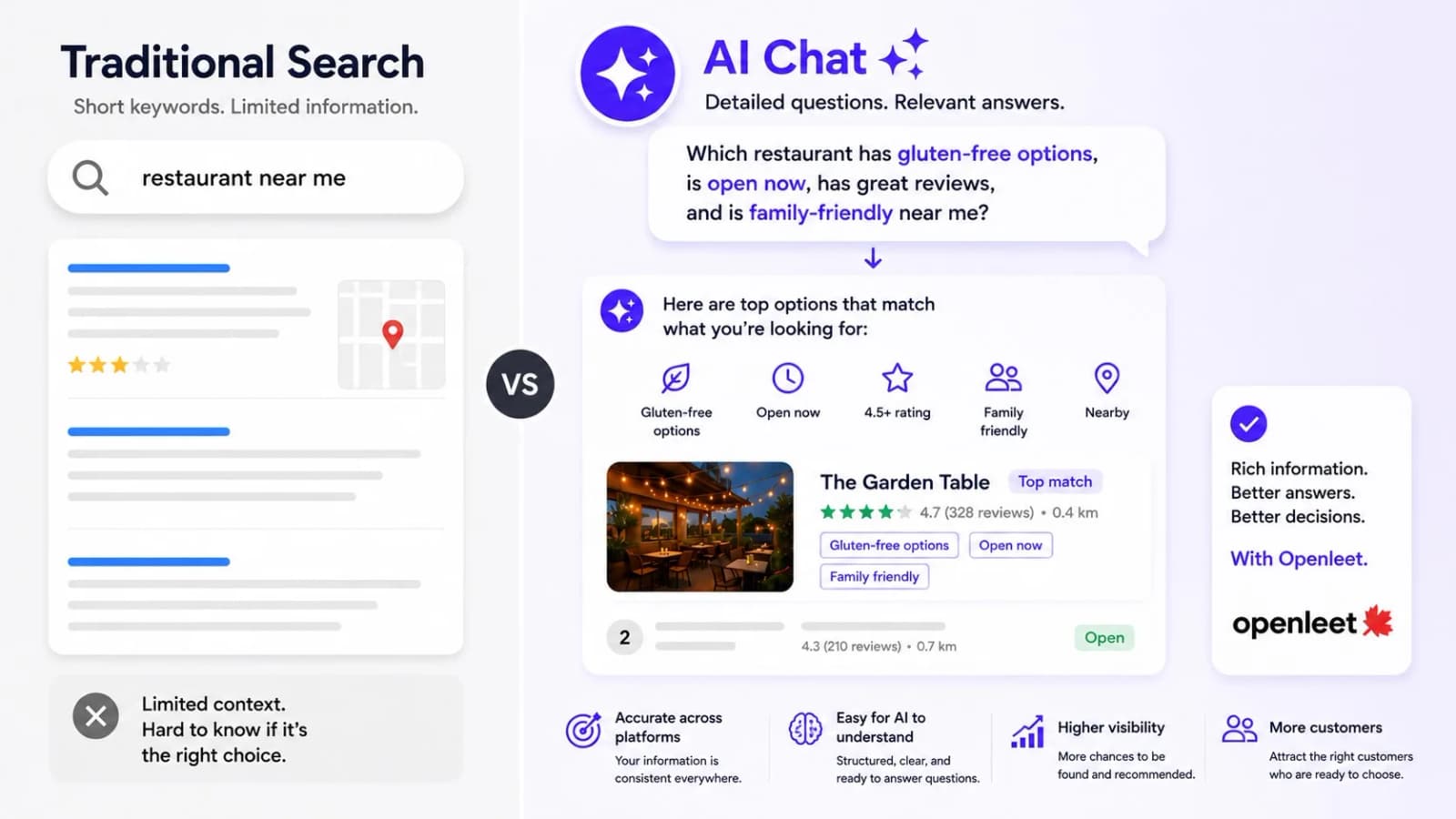
That distinction is important. Customers, search engines, and AI assistants increasingly depend on clear and reliable business information. A successful digital presence should communicate what the business actually offers—not generic claims generated without operational knowledge.
A booking system grounded in the real business
Openleet Booking is designed to connect customer convenience with operational reality.
Customers receive an accessible way to choose a service, find a suitable time, provide the right information, and stay informed. Businesses gain control over availability, capacity, resources, service areas, confirmations, and appointment history.
The strength of the system is not simply that it accepts bookings.
Its strength is that the booking reflects the business behind it.