


Article
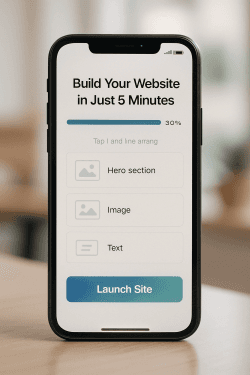
Build Your Website in Just 5 Minutes
No coding, no confusion, No graphic design. Just tap, type, and launch your business online—right from your phone.
Openleet helps businesses get found, build trust, and stay visible in the AI era through connected profiles, structured data, and modern business websites.
Professional, scientific and technical services
Openleet is an AI-ready business presence platform that helps small and medium-sized businesses create structured profiles, directory listings, and websites designed to be understood by customers, search engines, and AI assistants.
Canada
Slogan: "Be the Business AI Recommends."
Read articles and updates published by this business on Openleet.
No coding, no confusion, No graphic design. Just tap, type, and launch your business online—right from your phone.

From websites to booking tools — OpenLeet brings everything you need in one place. ✓ Mobile-friendly website builder ✓ Booking & reservation tools ✓ Business profile & directory listing ✓ Custom domain, email, and more
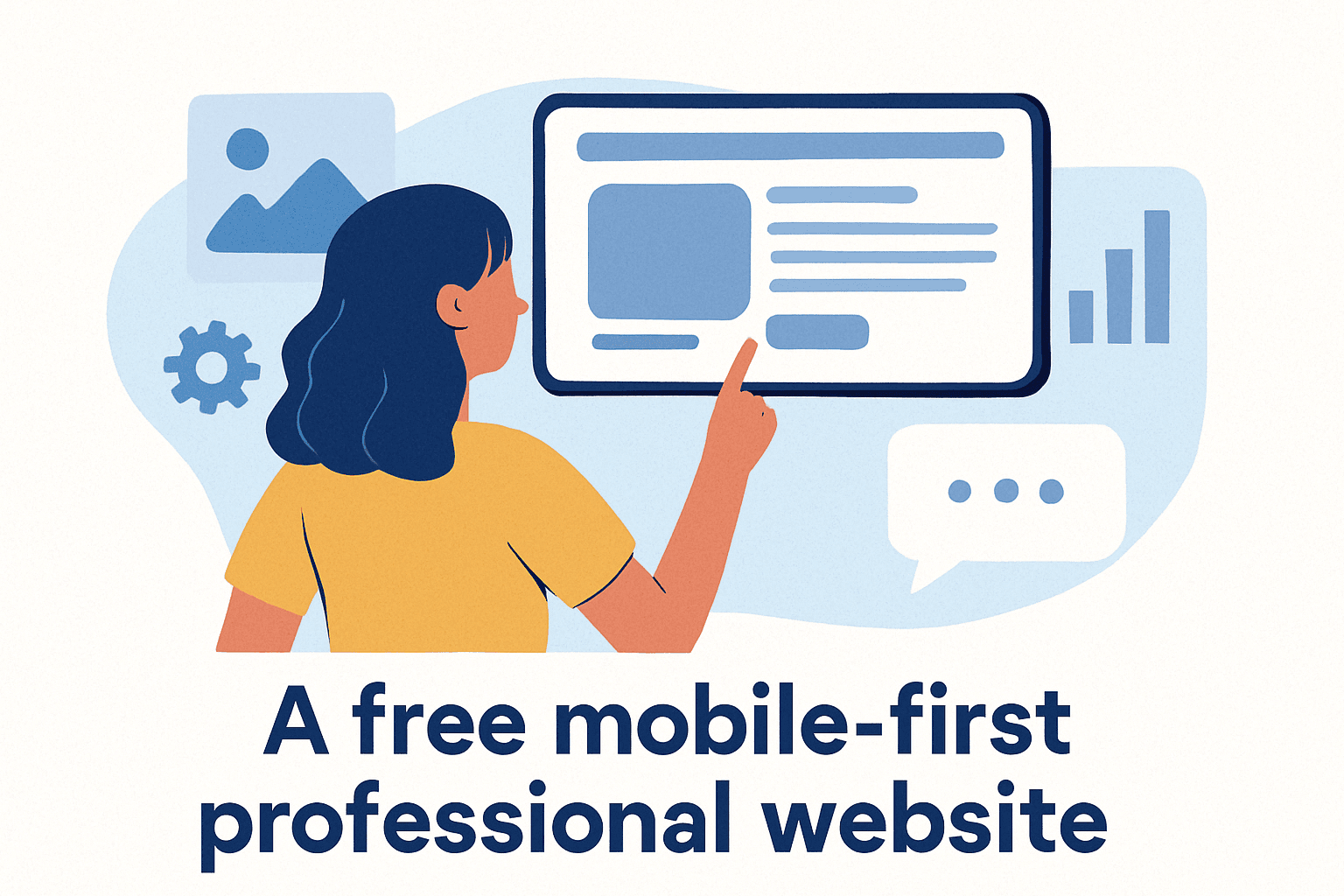
Build a Free, Mobile-First Website That Looks Professional. * - Designed to work perfectly on smartphones – just like your customers expect. * - Start for free. Upgrade only when your traffic grows. * - No coding. No stress. Just a stunning website that fits in your pocket. * - Optimized for performance, SEO, and user experience – straight from your phone.
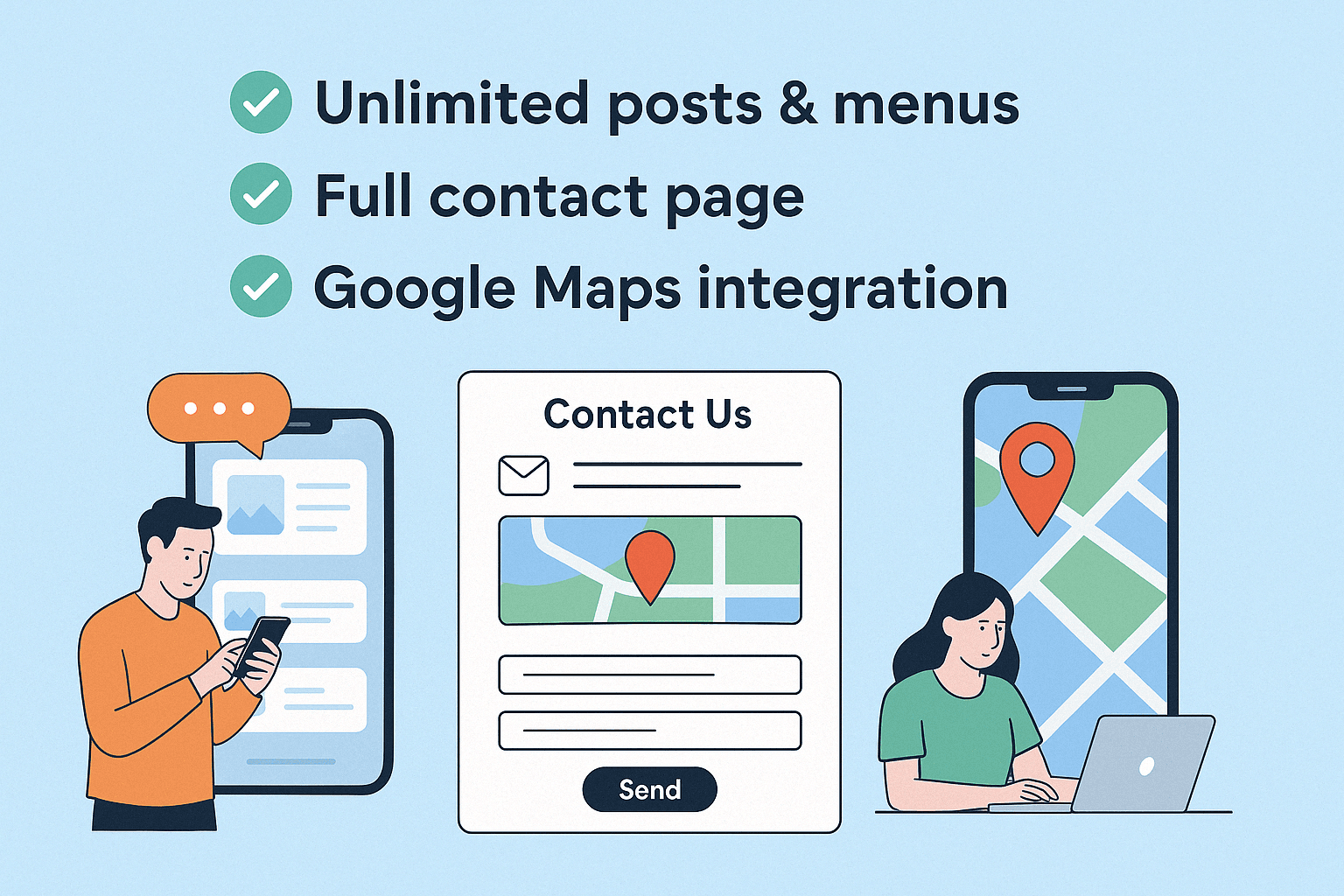
✅ Unlimited Posts & Menus Showcase your updates, services, or daily specials without limits. Perfect for restaurants, service providers, and creators alike. ✅ Complete Contact Page Let your visitors reach you effortlessly. Include your phone, email, location, and more. ✅ Google Maps Integration Help customers find you with a built-in map and clear driving directions. ✅ Quick Contact Form Receive customer inquiries or questions directly through a simple, mobile-friendly form. All-in-one, mobile-first, and totally free to start. Get discovered. Get connected.
WHEN A CUSTOMER ASKS CHATGPT OR GEMINI FOR A LOCAL RECOMMENDATION, DOES YOUR BUSINESS EXIST? Traditional SEO was built around keywords, backlinks, and human visitors. But the internet is changing. We have entered the era of AI-assisted discovery, where tools like ChatGPT, Gemini, Claude, Perplexity, and other AI assistants are increasingly helping people find businesses, products, and services. These systems don't browse the web the same way humans do. They evaluate information, compare sources, and look for structured, trustworthy data they can understand and reference. If your business relies on a website that is difficult for machines to interpret, important information may be hidden behind complex layouts, disconnected pages, or incomplete business data. When that happens, AI systems have less confidence in understanding and recommending your business. THAT'S ONE OF THE REASONS WE BUILT OPENLEET. Openleet focuses on turning business information into a connected, structured, machine-readable presence. We call this an Information Knot — a unified knowledge layer that connects your business profile, services, products, locations, articles, contact details, and other important information into a format that customers, search engines, and AI assistants can understand. The goal is simple: * Make your business easier to discover * Make your information easier to verify * Make your online presence easier for AI systems to understand and recommend As search continues to evolve, businesses need more than a website. They need a trusted digital presence that works for both people and machines. The future of discovery is already here. The question is: when someone asks an AI assistant for a recommendation in your industry, will your business be part of the answer? 👉 Create your AI-ready business presence today at Openleet.com — free to get started and no credit card required. #AIReadyBusiness #GenerativeEngineOptimization #AIVisibility #LocalBusiness #SmallBusiness #DigitalPresence #AgenticWeb #Openleet
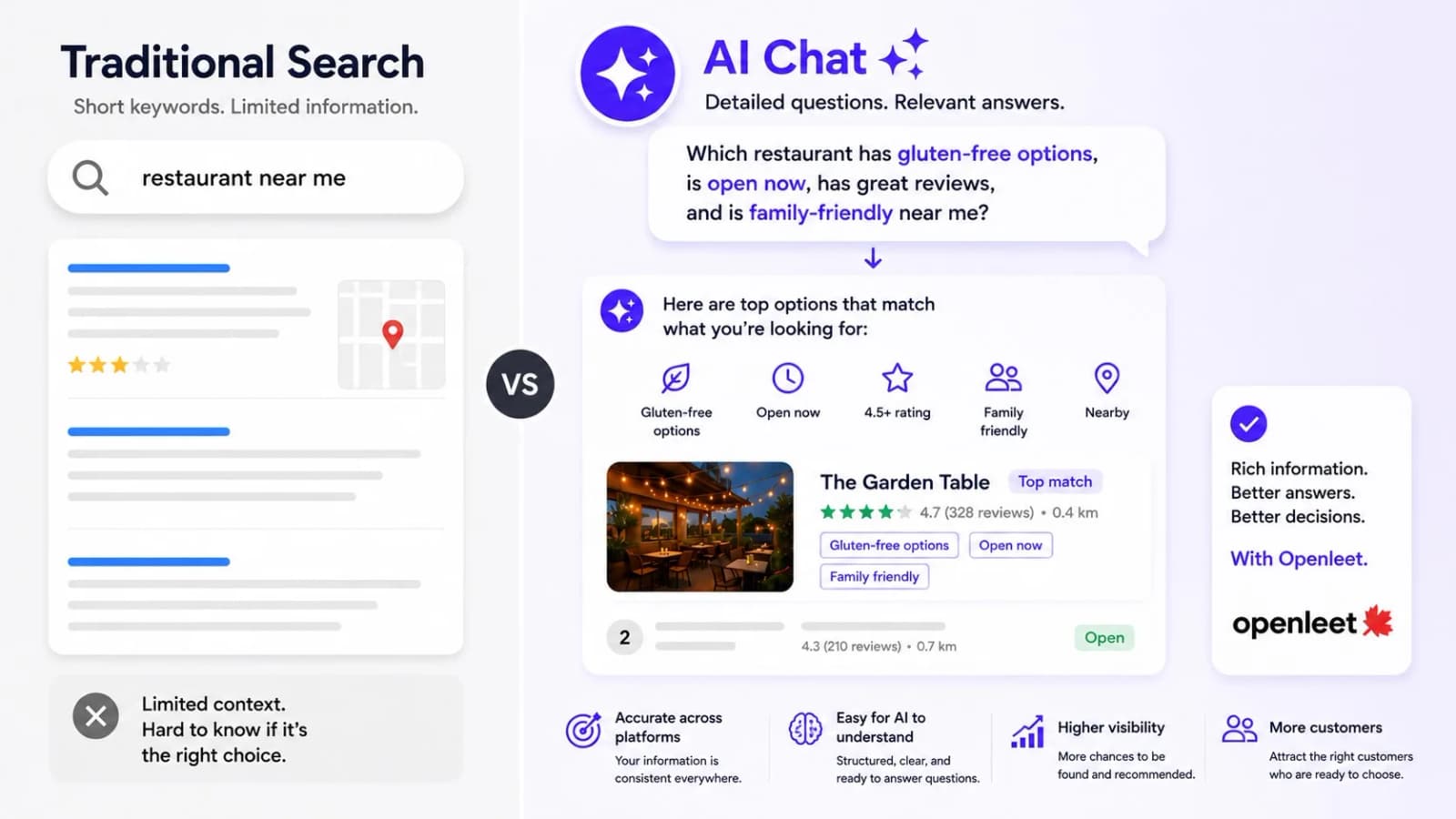
TODAY'S CUSTOMERS DON'T JUST SEARCH—THEY ASK QUESTIONS A few years ago, finding a business online usually meant typing a few words into Google: "restaurant near me," "daycare near me," or "accountant in Squamish." Today, that behavior is changing. Customers are increasingly asking AI assistants detailed questions like: > Which restaurant has gluten-free options, is open now, has great reviews, and is family-friendly? This is more than a new way to search. It is a new way people choose businesses. AI ISN'T LOOKING FOR A WEBSITE. IT IS LOOKING FOR ANSWERS. Many businesses rely on a website, a Google Business Profile, and occasional social media posts. These are still important, but they are often not enough for today's AI-driven search behavior. AI assistants need clear, current, and detailed information to answer customer questions confidently. If your hours are outdated, your services are vague, your menu is missing, or your information is scattered across different websites, AI may not have enough confidence to recommend your business. THE SHIFT IS ALREADY HAPPENING Consumer behavior is moving quickly. Research from local search and consumer behavior studies shows that more people are using AI tools to find local business recommendations, compare options, and make decisions. At the same time, search results are changing. AI answers and zero-click search results mean customers may get information about a business before they ever visit its website. In simple terms, your business information now needs to be understandable not only to people, but also to search engines and AI assistants. WHAT HAPPENS IF YOUR INFORMATION IS INCOMPLETE? If AI finds different versions of your business online, confidence drops. * Your website says you close at 8:00 p.m. * A directory says you close at 9:00 p.m. * Your social profile has not been updated in years. * Your services are listed differently across platforms. When this happens, AI may give a vague answer, choose another business, or leave your business out entirely—not because your business is worse, but because your information is harder to trust. WHAT BUSINESSES SHOULD DO NOW Preparing for AI search does not mean becoming a technical expert. It means keeping your business information accurate, complete, consistent, and easy to understand. Businesses should: * Keep their business name, address, phone number, and hours consistent everywhere. * Publish detailed services, products, menus, pricing, policies, and FAQs. * Update information whenever the business changes. * Clearly explain what they offer. * Use structured business information that search engines and AI systems can understand. * Regularly check what AI tools say about their business and competitors. HOW OPENLEET HELPS Openleet was built to make this easier and more affordable for small businesses. Instead of asking business owners to manage scattered information across websites, directories, social media pages, and search platforms, Openleet provides one place to organize, manage, and publish clear business information. With Openleet, businesses can keep their profile, services, products, hours, location, contact details, FAQs, and other important information accurate and consistent across their online presence. That makes it easier for customers, search engines, and AI assistants to find your business, understand what you offer, and recommend you with confidence. THE COST OF WAITING Businesses that ignore this shift may still have a website and still appear in traditional search results, but they may become increasingly difficult for AI assistants to understand and recommend. As more customers ask direct questions instead of browsing dozens of websites, businesses with incomplete, outdated, or inconsistent information risk being overlooked—even when they are the better choice. FINAL THOUGHT The next customer may never visit your homepage first. They may simply ask: > Who is the best option for what I need right now? Whether your business becomes part of that answer depends on how clearly and confidently your information can be found, understood, and trusted. That's the challenge modern businesses face—and it's exactly the problem Openleet helps solve. SOURCES AND FURTHER READING * BrightLocal — Local Consumer Review Survey * Yext — Consumer Search Behaviors Report * Pew Research Center — AI search and consumer behavior research * Search Engine Land — AI search and zero-click search articles * SparkToro — Zero-click search studies * Semrush — AI Visibility Index * McKinsey & Company — Generative AI and marketing research * Gartner — AI search and digital transformation forecasts
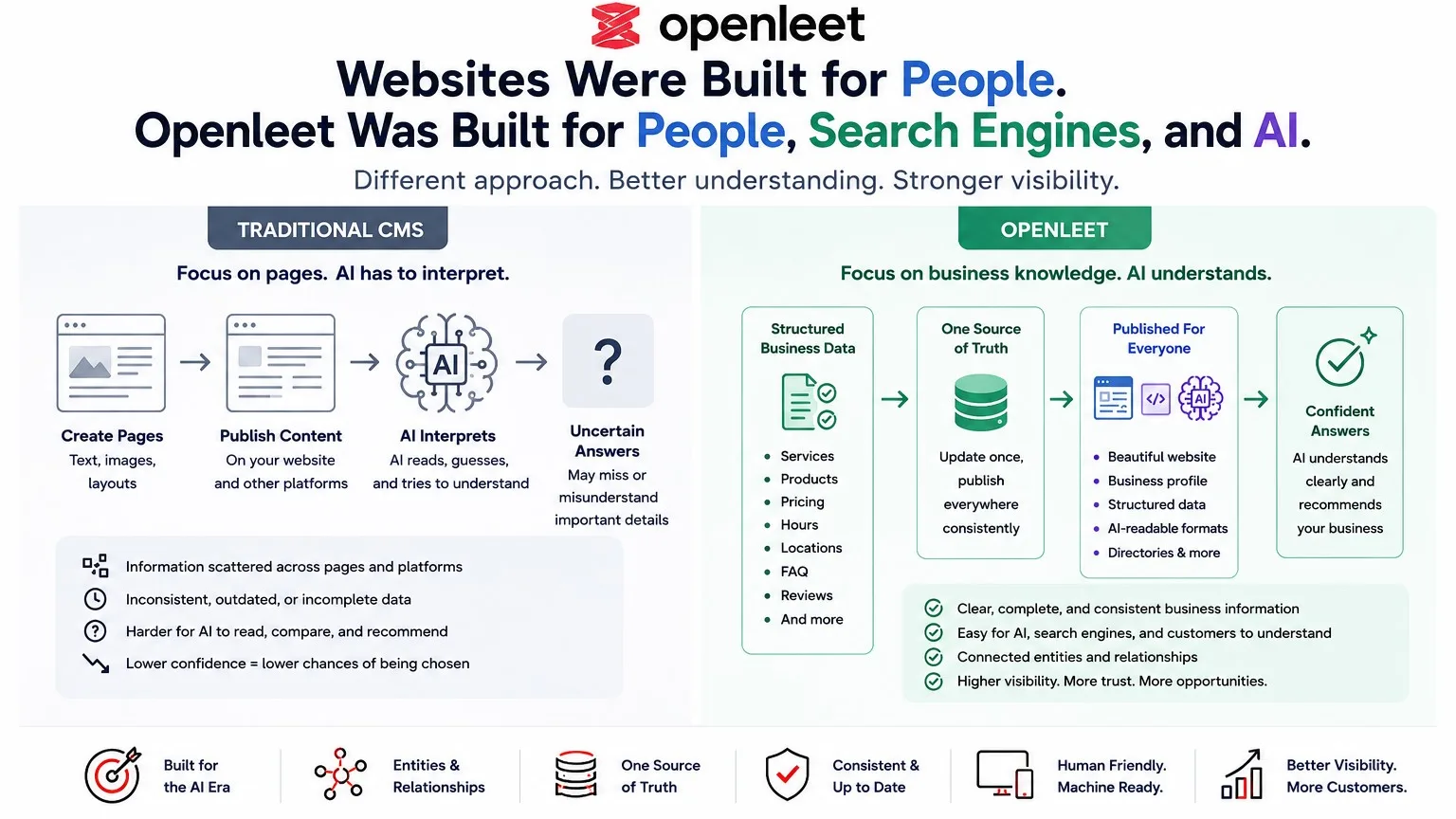
WEBSITES WERE BUILT FOR PEOPLE. OPENLEET WAS BUILT FOR PEOPLE, SEARCH ENGINES, AND AI. For more than 30 years, websites have been the foundation of a business's online presence. They help customers learn about a company, explore products and services, and decide whether to get in touch. That hasn't changed. What has changed is how customers discover businesses. Today, many people don't start by visiting a homepage. They ask AI assistants questions like: > Which daycare near me has infant care, outdoor play, flexible hours, and good reviews? or > Find an accountant that specializes in small businesses and offers online meetings. The AI doesn't browse websites the way people do. It tries to understand facts, compare businesses, and answer questions directly. That shift changes what businesses need to publish online. ---------------------------------------- TRADITIONAL CONTENT MANAGEMENT SYSTEMS WERE BUILT FOR PAGES Most website builders and content management systems are excellent at creating beautiful websites. They help businesses build: * Homepages * About pages * Service pages * Blog posts * Image galleries * Contact pages These systems focus on presentation. Their goal is to create websites that people enjoy reading. And they do that very well. But AI has a different challenge. It must understand the business behind those pages. ---------------------------------------- AI DOESN'T READ LIKE A HUMAN A visitor instantly understands this sentence: > "We provide bookkeeping services for small businesses in Squamish." An AI assistant has to determine: * Is bookkeeping the primary service? * Is it available only in Squamish? * Is it available remotely? * Is it for corporations? * Is pricing available? * Is this service still active? * Is this the current information? It often has to infer those answers from paragraphs of text. Sometimes it succeeds. Sometimes it doesn't. ---------------------------------------- GUESSING CREATES UNCERTAINTY Many businesses unknowingly publish information that is easy for people to understand but difficult for machines to interpret. For example: A service is described differently on the website than on a directory. Business hours are updated on Google but not on the website. Pricing exists inside a PDF. Products appear only in images. Important details are scattered across multiple platforms. Humans can usually work through those inconsistencies. AI systems become less confident. And when confidence drops, recommendations become less likely. ---------------------------------------- OPENLEET STARTS WITH BUSINESS KNOWLEDGE Openleet takes a different approach. Instead of starting with webpages, it starts with business information. Every piece of information is treated as structured knowledge. For example, a service isn't just a paragraph on a webpage. It becomes a complete business entity with information such as: * Service name * Description * Category * Availability * Pricing * Service area * Frequently asked questions * Images * Related products * Related articles * Structured data The same applies to: * Products * Menu items * Events * Articles * Locations * Contact methods * Business hours * Reviews This creates a structured understanding of the business before a webpage is even generated. ---------------------------------------- ONE SOURCE OF TRUTH One of the biggest challenges for businesses is keeping information consistent. The same information often exists in multiple places: * Website * Google Business Profile * Social media * Directories * PDFs * Menus * Brochures Eventually, something becomes outdated. Openleet is designed around a single source of truth. Business information is entered once, organized in one place, and then published consistently across the business profile, website, structured data, and other machine-readable formats. When information changes, it can be updated from one central source. ---------------------------------------- BUILT FOR HUMANS AND MACHINES Openleet does not replace a beautiful website. Instead, it generates information in forms that different audiences can understand. For people: * Clean webpages * Images * Articles * Menus * Service pages * Contact information For search engines: * Structured data * Entity relationships * Business metadata * Semantic organization For AI assistants: * Clearly defined facts * Relationships between business information * Consistent business entities * Machine-readable business knowledge Instead of asking AI to interpret everything, Openleet explains the business in a language machines understand. ---------------------------------------- RELATIONSHIPS MATTER Businesses are not collections of unrelated pages. Everything is connected. A service belongs to a business. A location offers specific services. A menu item belongs to a menu. An article explains a service. A product has pricing, availability, and frequently asked questions. Openleet preserves these relationships. That helps search engines and AI understand not only individual pieces of information, but how they fit together. ---------------------------------------- BEYOND CONTENT MANAGEMENT Traditional content management systems organize webpages. Openleet organizes business knowledge. That difference may sound subtle, but it changes how information is created, maintained, and discovered. Instead of asking: "Which page should I add this information to?" Openleet asks: "What fact about your business should customers, search engines, and AI know?" That information can then be published wherever it is needed. ---------------------------------------- DESIGNED FOR THE NEXT GENERATION OF SEARCH Search is changing. Customers increasingly expect direct answers instead of lists of links. AI assistants are becoming another way people discover businesses. Businesses that publish clear, complete, and structured information are easier to understand and easier to recommend. This isn't about replacing websites. It's about making websites part of a broader, connected knowledge system. ---------------------------------------- THE OPENLEET DIFFERENCE Openleet was built around a simple idea: Business information should only need to be organized once. From that single source of truth, Openleet helps businesses create: * A professional business profile * A modern website * Structured data for search engines * AI-readable business information * Connected products, services, articles, menus, events, and locations The result is an online presence that works for today's customers while preparing businesses for how discovery is evolving. Because the future of the web isn't just about creating more pages. It's about making business information easier for people, search engines, and AI to understand, trust, and recommend.
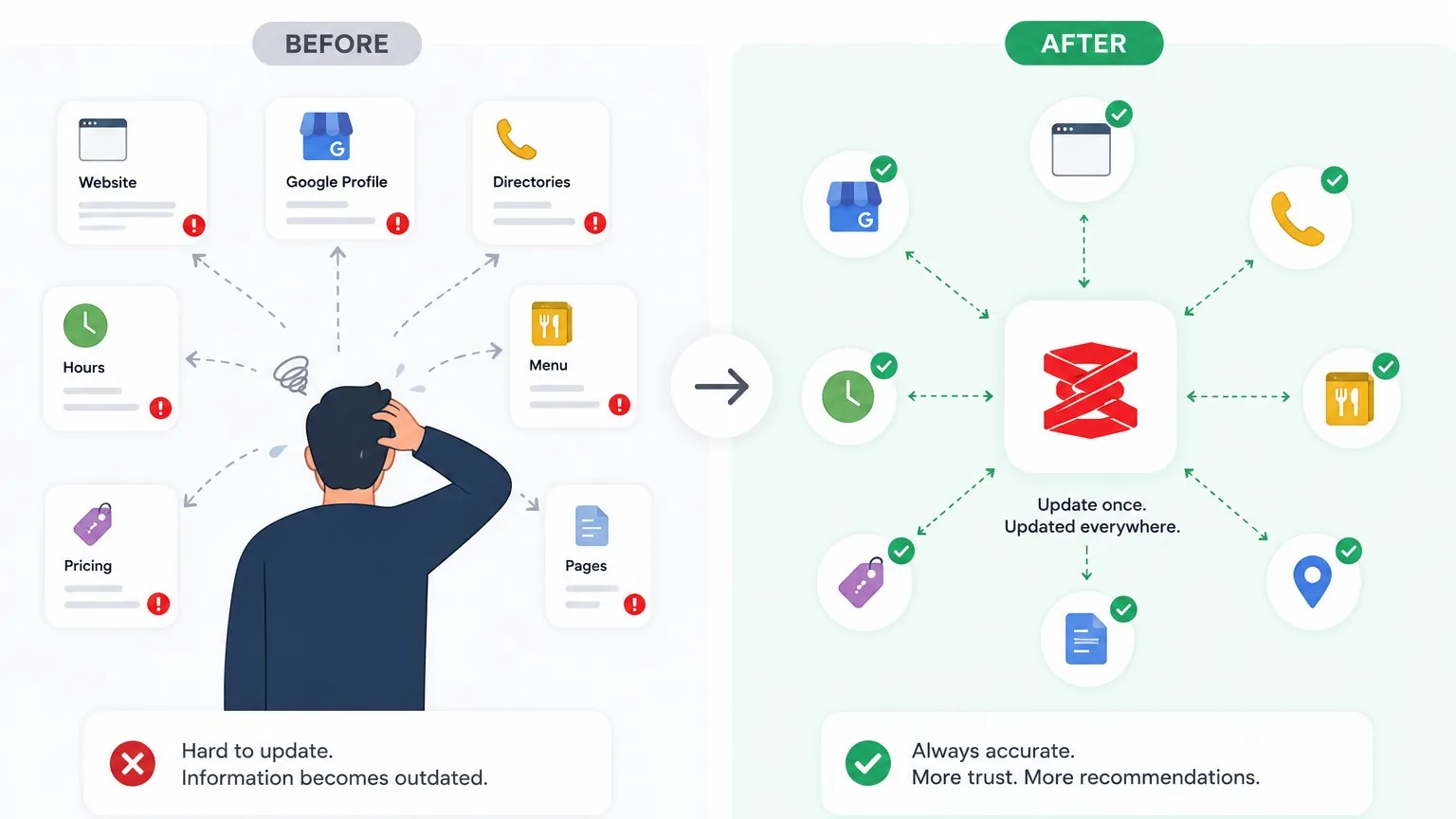
WHY KEEPING YOUR BUSINESS INFORMATION UPDATED MATTERS MORE THAN EVER Most business owners know they should keep their website updated. The challenge isn't understanding why—it's finding the time. A new service is added. Business hours change. A phone number is updated. Holiday hours are different. Prices increase. A menu changes. Someone joins the team. A location moves. Each change may seem small, but keeping every part of your online presence accurate quickly becomes a full-time job. Today, that matters more than ever. ---------------------------------------- AI CAN ONLY RECOMMEND WHAT IT TRUSTS Customers are increasingly asking AI assistants questions like: > Is this business open today? > Do they offer emergency service? > Do they have gluten-free options? > Do they provide online consultations? To answer those questions, AI gathers information from many sources. If your business information is clear, current, and consistent, AI can answer confidently. If different websites show different information, confidence decreases. The result isn't always a wrong answer. Sometimes your business simply isn't recommended. ---------------------------------------- OUTDATED INFORMATION HURTS MORE THAN CUSTOMER EXPERIENCE Years ago, outdated information mostly frustrated customers. Someone might call after arriving at the wrong time. Or visit a service page with outdated pricing. Today, outdated information affects something much larger. It affects trust. Search engines and AI assistants constantly compare information from different sources. If they find conflicting details, they become less certain about which information is correct. That uncertainty can make your business harder to recommend—not because your business isn't good, but because your information isn't consistently reliable. ---------------------------------------- UPDATING TRADITIONAL WEBSITES ISN'T ALWAYS EASY Most websites were designed to publish pages. Changing information often means: * Finding the correct page * Editing HTML or a visual editor * Making sure fonts still match * Checking spacing * Preserving colors * Avoiding layout issues * Updating several different pages * Republishing the website Now repeat that process for: * Business hours * Contact information * Services * Pricing * FAQs * Team members * Menus * Locations Many business owners postpone updates simply because they take too much time. Eventually, outdated information accumulates. ---------------------------------------- OPENLEET MAKES UPDATING BUSINESS INFORMATION SIMPLE Openleet takes a different approach. Instead of asking you to edit webpages, Openleet asks you to update your business information. Need to change your hours? Update one field. Added a new service? Complete a simple form. Changed your phone number? Edit it once. No HTML. No page builders. No worrying about fonts, layouts, colors, or formatting. You simply update the information that changed. ---------------------------------------- ONE CHANGE. EVERYWHERE UPDATED. This is one of the biggest differences between Openleet and traditional content management systems. When business information changes, Openleet can update it consistently across your online presence, including: * Your business profile * Your website * Service pages * Product pages * Contact information * Structured data * Business metadata * AI-readable formats Instead of maintaining multiple versions of the same information, you maintain one trusted source. ---------------------------------------- BUILT AROUND BUSINESS INFORMATION, NOT WEBPAGES Traditional content management systems organize content by pages. Openleet organizes information by business entities. Your services aren't just paragraphs. They're services. Your products aren't just text. They're products. Your locations aren't just contact pages. They're structured locations with hours, contact methods, service areas, and relationships to the rest of your business. That structure makes updates faster, simpler, and far more consistent. ---------------------------------------- FRESH INFORMATION BUILDS TRUST Keeping information current doesn't guarantee higher rankings or more AI recommendations. But fresh, accurate, and consistent information helps customers, search engines, and AI systems better understand your business. An active business that regularly updates: * Services * Business hours * Pricing * Products * Events * FAQs * Photos is easier to understand than one whose information hasn't changed in years. Accurate information builds confidence. Confidence helps people make decisions. ---------------------------------------- MORE TIME RUNNING YOUR BUSINESS Business owners shouldn't have to become website experts every time something changes. Updating your business should feel as simple as updating your contact information. That's why Openleet separates business information from website design. You focus on your business. Openleet takes care of presenting that information consistently for customers, search engines, and AI. ---------------------------------------- THE FUTURE ISN'T ABOUT UPDATING MORE PAGES As AI becomes a larger part of how people discover businesses, keeping information accurate is no longer just good website maintenance. It's part of building a trustworthy online presence. Businesses that can update information quickly are better prepared to keep customers informed, reduce confusion, and ensure their digital presence reflects what's happening in the real world. That's why Openleet wasn't designed as just another website builder. It was designed as a platform where your business information has one source of truth—making it easier to keep your website, business profile, structured data, and AI-readable information accurate, current, and connected. Because in the future of online discovery, the businesses that are easiest to keep up to date are also the easiest to understand.
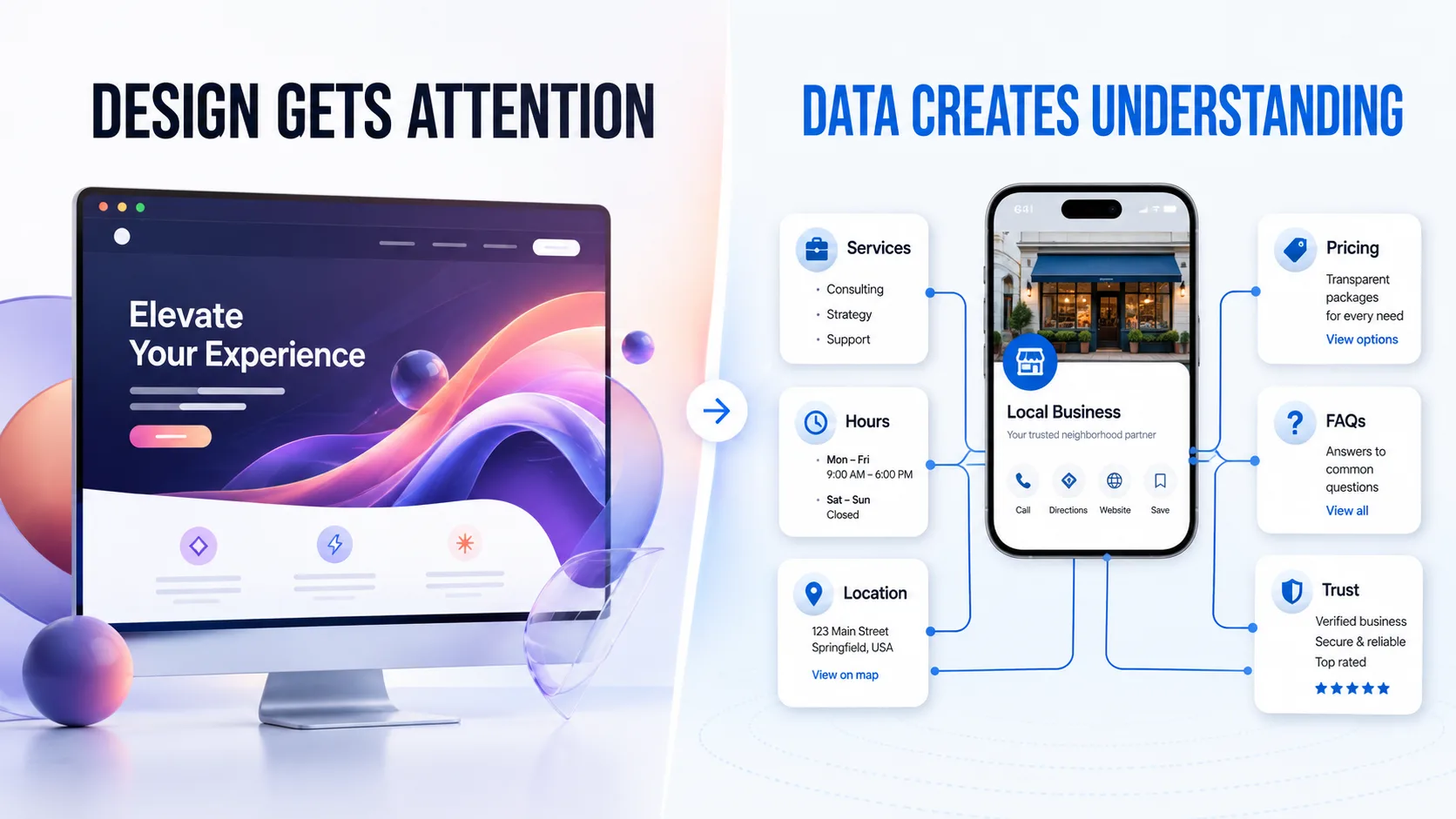
WEBSITE DESIGN OR BUSINESS DATA: WHAT MATTERS MORE? A successful business website needs both good design and useful information—but they do different jobs. Design creates an impression and makes information pleasant to use. Business data helps customers, search engines and AI assistants understand what the business offers, where it operates and why someone should choose it. As online discovery becomes more conversational and increasingly happens without a website visit, accurate and well-organized business information is becoming more important than ever. THE BEAUTIFUL-WEBSITE QUESTION When some business owners plan a new website, their first questions concern its appearance: * Will it look modern? * Can it include animations and motion effects? * Can we use a large video across the homepage? * Can every section have a distinctive design? * Will it look more impressive than competitors’ websites? These are reasonable questions. A website represents the business, and an outdated or confusing design can create the wrong impression. But another question must come first: > After seeing the website—or asking an AI assistant about the company—will someone clearly understand the business? A website can look exceptional and still leave important questions unanswered. It may not clearly explain its services, prices, service area, availability, qualifications, policies or what makes the business different. The result is a beautiful website that communicates surprisingly little. SOME BUSINESSES GENUINELY NEED DESIGN TO LEAD Visual presentation is especially important when the business itself sells visual talent, entertainment or creative expertise. For example: * Architects need to showcase their buildings and design approach. * Artists and illustrators need a strong visual portfolio. * Photographers need images that demonstrate their abilities. * Interior designers need to present spaces and transformations. * Film studios need video and motion to communicate their production quality. * Graphic designers need their own websites to demonstrate visual judgment. * Fashion and luxury brands often use design to establish a particular feeling. For these businesses, the website is not merely a container for information. It is part of the portfolio and evidence of the company’s abilities. Even then, presentation cannot completely replace information. A visually impressive architecture website still needs to describe project types, locations, expertise, processes and how clients can start a conversation. The appropriate balance depends on what customers need to see before making a decision. MOST LOCAL BUSINESSES HAVE A DIFFERENT PRIORITY A childcare centre, restaurant, contractor, accountant, repair company or cleaning service has a different challenge. Its prospective customers are usually trying to answer practical questions: * What exactly does this business offer? * Does it serve my location? * Is it open when I need it? * How much might the service cost? * Is it qualified, licensed or insured? * Does it have experience with my particular problem? * What do previous customers say? * How can I make an appointment? * What should I expect after contacting the business? For these companies, being understood, found and trusted usually matters more than sophisticated visual effects. A contractor does not necessarily need an elaborate animated homepage. The contractor needs customers to understand the types of projects accepted, areas served, relevant licences, previous work and how to request an estimate. A childcare provider needs to publish age groups, hours, availability, enrolment procedures, qualifications, safety measures and program details. A restaurant needs an accessible menu, prices, hours, address, dietary information, reservation options and clear photographs. Design should make this information easier to find and understand. It should not become a substitute for the information. CUSTOMERS INCREASINGLY RECEIVE ANSWERS WITHOUT VISITING WEBSITES The traditional search journey was relatively simple: 1. A customer searched for something. 2. The search engine displayed a list of links. 3. The customer visited several websites. 4. The customer compared the businesses. 5. The customer made a decision. That journey is changing. Customers can now ask ChatGPT, Gemini, Claude, Perplexity and AI-powered search engines complete questions. Instead of receiving only a list of links, they may receive a summarized answer, a comparison or a short list of suggested options. Google’s AI Overviews are also placing generated answers directly above conventional search results. This means that a person can learn about a subject—or sometimes compare available options—without visiting the original websites. A 2025 Pew Research Center study examined 68,879 Google searches made by 900 U.S. adults. It found that: * Users clicked a conventional search result in 8% of visits when an AI summary appeared. * Without an AI summary, they clicked a search result in 15% of visits. * A source cited inside the AI summary received a click in only 1% of visits. * Browsing ended after 26% of searches with an AI summary, compared with 16% without one. The study does not prove that websites are becoming unnecessary. It shows that websites can influence a customer’s discovery and decision without necessarily receiving a visit. A separate SparkToro and Datos zero-click study estimated that only 360 of every 1,000 U.S. Google searches resulted in a visit to the open web. The European figure was 374 per 1,000 searches. These findings point toward a significant change: > Your website is no longer communicating only with the people who open it. Its information may also be processed by search engines, crawlers and AI systems that help people make decisions elsewhere. AI CANNOT BE IMPRESSED BY ANIMATION A customer may appreciate an attractive animation, carefully selected typography or an elegant transition between sections. These features can strengthen the experience and reinforce the brand. But a crawler or AI system is primarily trying to identify information and relationships: * What is the business called? * What type of business is it? * What services or products does it offer? * Where does it operate? * What are its hours? * Who are its services intended for? * What qualifications and trust signals are available? * What prices, policies or availability information has it published? * How recently was the information updated? * Do different pages provide consistent details? A motion effect cannot answer these questions. A background video cannot replace an accurate service description. A beautiful photograph does not communicate opening hours unless that information is also provided in accessible text and, where appropriate, structured data. This does not make design irrelevant. It changes the job design must perform. Good design should help people reach the information. It should not hide the information beneath effects, vague slogans or unnecessary interactions. MOBILE SCREENS HAVE SIMPLIFIED WEBSITE DESIGN The claim that 86% of website traffic comes from smartphones is not supported by reliable global traffic measurements. The exact proportion varies significantly by industry, country and measurement method. Nevertheless, mobile devices represent the largest or one of the largest sources of web traffic. Similarweb estimated that mobile accounted for approximately 65% of worldwide web traffic in June 2026, while Statcounter measured mobile at approximately 52% for the same month. The difference shows why statistics should always be presented with their source and methodology. Similarweb platform statistics, Statcounter platform statistics On a narrow mobile screen, much of the visual complexity designed for a desktop must be rearranged or simplified. Multiple columns become one column. Large navigation menus collapse. Some animations are reduced. Text, images, videos and buttons are generally stacked vertically. This does not mean that designers cannot create excellent mobile experiences. Skilled designers can do a great deal with spacing, typography, colour, imagery, hierarchy and interaction. It does mean that clarity becomes more important than decoration. Mobile visitors usually need to quickly understand: * Where they are * What the business provides * Whether it is relevant to them * Whether they can trust it * What they should do next Google also uses mobile-first indexing and recommends responsive design, reinforcing the importance of making the same essential information accessible on mobile devices. Google’s mobile-first indexing guidance DESIGN AND DATA ARE NOT OPPONENTS It is tempting to make the argument simple: > Data is important, so design is unimportant. That would be a mistake. Poor design can make excellent information difficult to read. Confusing navigation can prevent customers from finding services. Weak typography can reduce accessibility. Slow, excessive animation can frustrate visitors. An unprofessional visual presentation can reduce trust. Design and data should therefore work together: Business data providesDesign providesClear factsClear presentationServices and product detailsVisual hierarchyHours and locationsEasy navigationPrices and availabilityReadabilityQualifications and policiesProfessional impressionCustomer questions and answersUsable interactionMachine-readable meaningHuman-friendly experienceInformation for discoverySupport for conversion Design helps people experience the business. Data helps people and machines understand it. For most small businesses, the correct order is: 1. Determine what customers need to know. 2. Organize and publish that information. 3. Make it accessible to search engines and AI systems. 4. Design a clear, attractive experience around it. 5. Keep the information accurate over time. THE DIY WEBSITE TREND REFLECTS A PRACTICAL NEED Many small-business owners do not want to hire a designer every time they change a price, add a service, update their hours or publish a new project. This is one reason do-it-yourself website services have become popular. Business owners want greater control, lower ongoing costs and the ability to make changes quickly. But many DIY builders still begin with a visual template. They ask the owner to choose colours, fonts and layouts before helping them determine which business facts customers actually need. The result may be a polished website containing generic text, incomplete service information and details that are difficult to maintain. For a business that primarily needs to be discovered and understood, the process should begin with information—not a template. WHAT AN INFORMATION-FIRST BUSINESS PRESENCE REQUIRES A useful business presence should allow an owner to manage more than a homepage introduction. It should organize the company as a collection of connected entities. These may include: * Business identity and description * Categories and specialties * Locations and service areas * Hours and special hours * Contact methods * Individual services * Products and offers * Pricing and availability * Frequently asked questions * Policies * Qualifications and certifications * Testimonials and reviews * Articles, projects and case studies * Photographs, videos and galleries Each item should have its own meaning and relationship to the rest of the business. For example, a service should not exist only as a sentence inside a large text block. It can have its own name, description, price, audience, availability, location, images, questions and supporting evidence. This makes the information more useful to customers and easier for digital systems to interpret. STRUCTURED DATA HELPS COMMUNICATE MEANING Web pages are primarily designed for people, but structured data gives search engines an additional machine-readable description of what the page represents. Google explains that structured data provides explicit clues about a page’s meaning. Depending on the content, it can describe a local business, product, event, article, review, offer or frequently asked question. Google’s introduction to structured data For a local business, structured data may communicate information such as: * Business type * Name and address * Opening hours * Telephone number * Location * Services * Products and offers * Ratings and reviews Structured data does not guarantee a higher ranking, enhanced search result, AI citation or recommendation. It helps systems identify information more clearly and reduces ambiguity. The quality of the underlying information still matters. Adding structured markup to inaccurate or incomplete information does not solve the real problem. WHY WE CREATED OPENLEET We created Openleet around a simple principle: > Small businesses need an easy way to introduce themselves clearly to customers, search engines, crawlers and AI systems. Openleet provides tools for business owners to organize, control and update their business information without rebuilding pages or relying on a designer for routine changes. Instead of treating the business as a collection of disconnected text blocks, Openleet organizes its information as connected entities—an approach we describe as an Information Knot. The business identity connects with its locations. Locations connect with hours and service areas. Services connect with prices, availability, images and frequently asked questions. Testimonials, articles, products and trust information add further context. Openleet can then present this information in different forms for different audiences: * A clear public business profile for customers * Individual pages for services, products and other content * Structured data for search engines * Machine-readable resources for crawlers and AI systems * Information that the business owner can update from one dashboard Openleet cannot guarantee that an AI assistant will recommend a particular business. No responsible platform can make that promise. What it can do is help a business publish clearer, more complete and more accessible information—giving customers and digital systems better material from which to understand it. WHAT SHOULD YOUR BUSINESS PRIORITIZE? Ask what your customers need before choosing you. If visual ability is the product, invest appropriately in a distinctive visual experience. Your website should demonstrate your creative standard. If your customers primarily need facts, confidence and a clear next step, begin with information: * Explain every important service. * Publish accurate hours and contact details. * Define your location and service area. * Answer common customer questions. * Present qualifications and trust signals. * Clarify pricing or explain how estimates work. * Keep the information current. * Make it accessible on mobile devices. * Use appropriate structured data. * Ensure people and machines can understand the same business. Once that foundation is established, design can make the experience more appealing, memorable and persuasive. THE FINAL ANSWER: DATA FIRST, DESIGN AROUND IT So, which matters more: website design or business data? For most local and service businesses, reliable business data must come first. Design attracts attention and influences trust. Business information establishes relevance, answers questions and helps customers make decisions. In an environment where an AI assistant or search summary may describe a company before the customer opens its website, that information may represent the business even when its visual design is never seen. The strongest business website is not necessarily the one with the most animation or elaborate effects. It is the one that makes the business easiest to understand, trust and choose. -- Build the information foundation first. Then use design to make that information work beautifully.
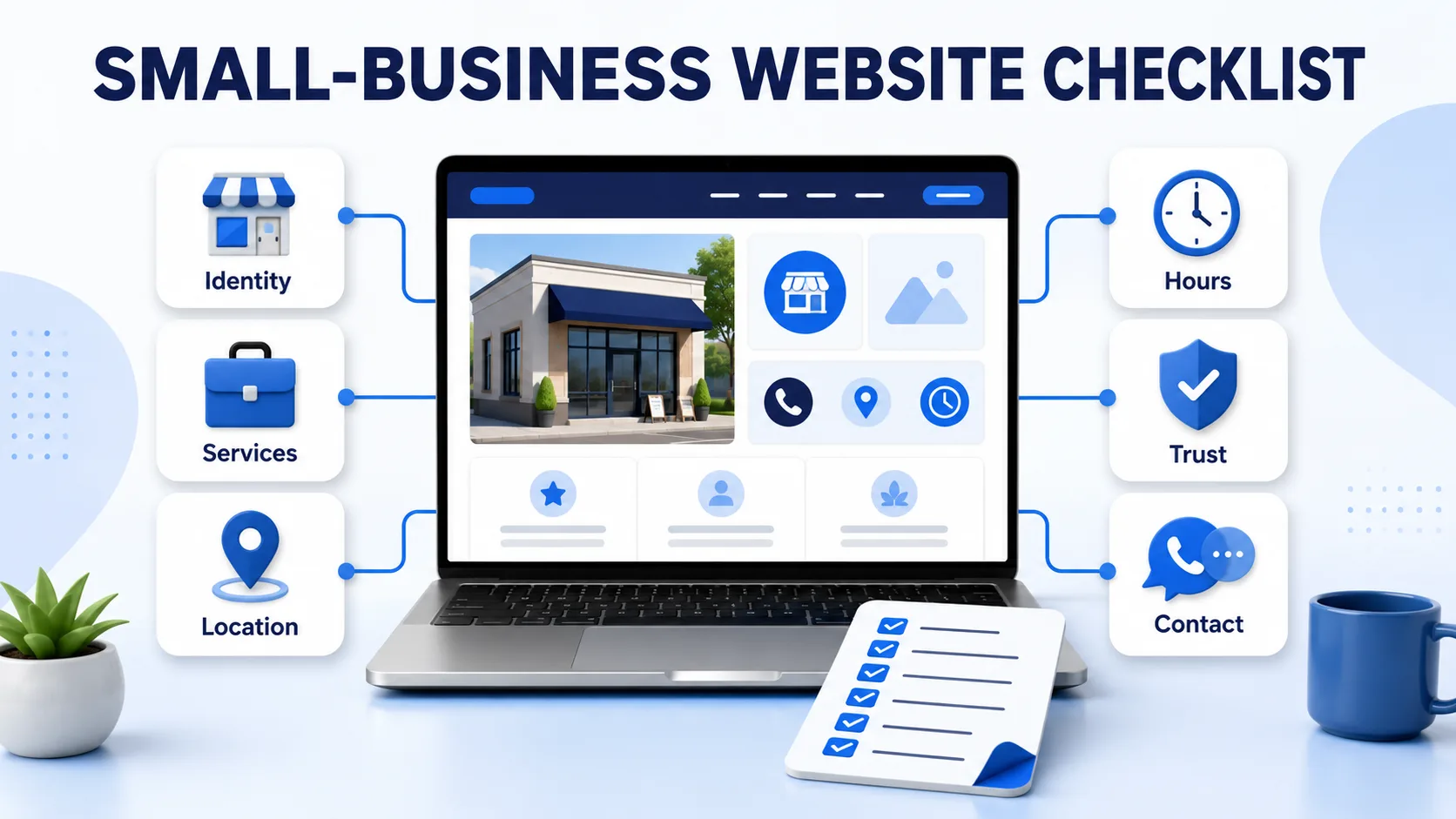
WHAT INFORMATION SHOULD EVERY SMALL-BUSINESS WEBSITE INCLUDE? A small-business website should do more than prove that the company exists. It should help a potential customer understand what the business offers, decide whether it fits their needs, trust the information and take the next step. The same information also helps search engines and AI assistants understand when the business may be relevant. If important details are missing, even an attractive website can leave the business difficult to find, compare and choose. This guide explains what every small-business website should include, which information matters most and how to organize it so that it remains useful to customers, search engines and AI systems. START WITH THE QUESTIONS CUSTOMERS NEED ANSWERED Before choosing pages, colors or templates, think about the questions a customer asks before making a decision: * What does this business provide? * Is it suitable for someone like me? * Does it serve my location? * Is it open or available when I need it? * What does it cost? * Why should I trust it? * What happens if I contact, book or buy? * How can I take the next step? A good website answers these questions clearly. It does not make visitors search through vague slogans, image galleries or several unrelated pages to find basic facts. 1. A CLEAR BUSINESS IDENTITY Every website should immediately identify the business. A visitor should not have to study the entire homepage to determine what the company does. Include: * The public business name * A recognizable logo or brand mark * The business category * A short, specific introduction * The primary audience or customer type * The main location or service area * A meaningful point of difference A useful opening statement often follows this structure: > [Business name] provides [products or services] for [customers] in [location]. For example: > North Shore Heating provides residential furnace repair, heat-pump installation and seasonal maintenance for homeowners in North Vancouver and West Vancouver. This communicates much more than a general slogan such as “Quality You Can Trust.” A slogan can support the identity, but it should not replace a clear explanation. How Openleet helps: Openleet separates the business name, category, slogan, short introduction, full description, audience and areas of expertise into organized fields. This makes the identity easier to maintain and present consistently across the public profile and machine-readable business information. 2. A USEFUL ABOUT SECTION An About page should help customers understand the people and experience behind the business. It should not be a long corporate history written only to fill space. Useful information can include: * Why the business was established * Who owns or operates it * The people or communities it serves * Relevant experience and qualifications * Its approach to service * Values that affect the customer experience * What makes it meaningfully different Specific statements are more credible than broad claims. Instead of saying “We are the best,” explain the experience, process or commitment that supports the claim. For a family business, the story may be important. For a regulated professional, qualifications may matter more. For a contractor, experience with particular project types may be the strongest evidence. How Openleet helps: A business can maintain its introduction, story, expertise and identity information in one profile instead of scattering slightly different descriptions across multiple pages. Openleet’s identity guidance can also help identify descriptions that are too broad, unclear or incomplete. 3. COMPLETE INFORMATION ABOUT EVERY IMPORTANT SERVICE One of the most common small-business website problems is a Services page that contains only a short list: * Installation * Repair * Maintenance * Consultation This tells a customer very little. Every important service should answer: * What is the service? * What problem does it solve? * Who is it designed for? * What is included? * What is not included? * What options or packages are available? * Where is it offered? * How long might it take? * What does it cost, or how is the price calculated? * What should the customer do next? Important services generally deserve their own pages. A dedicated page gives customers enough information to evaluate the service and gives search engines a clearer subject than a single page containing ten one-sentence offerings. Avoid creating many nearly identical pages merely to target different keywords or cities. Each service page should contain genuinely useful and specific information. How Openleet helps: Openleet treats each service as its own information object, with a title, description, price, availability, images, FAQs and other details. The service can have a dedicated public page while remaining connected to the business, location and related information. 4. PRODUCTS, MENUS OR CATALOGUES Businesses that sell products should publish more than photographs and product names. Depending on the product, include: * Product name and category * Clear description * Price and currency * Sizes, variations or options * Availability or stock status * Materials, ingredients or specifications * Dimensions or capacity * Suitable uses or intended customers * Delivery, pickup or shipping information * Return or warranty conditions * Relevant photographs or video Restaurants should make menus accessible as webpage content whenever possible, not only as a photograph or difficult-to-read PDF. Customers—and many digital systems—need to identify individual items, prices, descriptions and dietary information. How Openleet helps: Openleet provides structured content for products, menu items, offers and related media. This allows a business to update individual items without redesigning an entire page and gives each offering clearer meaning than an unstructured image or text block. 5. PRICES AND THE PURCHASING PROCESS Customers frequently want pricing information before they make contact. Not every business can publish an exact price, but almost every business can reduce uncertainty. Depending on the service, publish: * An exact price * A starting price * A typical price range * An hourly, daily or unit rate * Package options * Minimum charges * Factors that affect the final cost * Deposits, taxes or additional fees * Accepted payment methods * How estimates or consultations work If an exact price is impossible, explain why and describe what is required to prepare an estimate. “Contact us for pricing” gives the customer no idea what will happen next. Pricing transparency can also save the business time by reducing inquiries from customers whose needs or budgets do not match the service. How Openleet helps: Products and services in Openleet can include price, currency, unit, offers and availability details. Businesses can update these details without searching through multiple website pages whenever a price changes. 6. LOCATION AND SERVICE-AREA INFORMATION Customers need to know where the business operates and whether it can serve them. For a customer-facing location, include: * Full address * Map and directions * Building, unit or entrance instructions * Parking or transit information * Accessibility information * Telephone number for that location * Location-specific hours For a service-area business, identify the cities, communities or regions actually served. A statement such as “Serving British Columbia” may be too broad to help a customer understand whether the business works in their neighbourhood. Also clarify whether the service is: * On-site * At the business location * Mobile * Remote or online * Available for pickup or delivery How Openleet helps: Openleet can connect a business with one or more locations, addresses, contact details, hours and service areas. This is particularly helpful when different branches have different hours or when a service is available only in certain locations. 7. ACCURATE HOURS AND CURRENT AVAILABILITY Incorrect hours create frustration and quickly damage trust. Publish: * Regular opening hours * Appointment or service hours, if different * Holiday and special hours * Seasonal schedules * Emergency or after-hours availability * Expected response times * Typical lead times * Appointment, enrolment or product availability when appropriate If availability changes frequently, the website should make it clear when the information was updated and how customers can confirm it. How Openleet helps: Business owners can manage regular and special hours as organized information. This reduces the risk of hours being buried inside an old page or image and makes them easier to update and reuse across the business profile. 8. CONTACT INFORMATION AND A CLEAR NEXT ACTION Do not assume every visitor knows what to do after reading the website. Each important page should offer a relevant next step. Contact options may include: * Telephone number * Business email address * Contact form * Appointment or reservation link * Quote-request form * Store directions * Ordering instructions * Active messaging channels * Expected response time The appropriate action depends on the page. A service page may invite the customer to request an estimate. A restaurant page may offer directions, ordering or reservations. A childcare page may explain how to arrange a tour or join a wait-list. Forms should request only the information required for the next step. Long or confusing forms can discourage otherwise interested customers. How Openleet helps: Openleet connects contact methods and calls to action with the business profile and its content. This allows customers to move from learning about a service to calling, requesting information, visiting or booking without searching for contact details elsewhere. 9. TRUST SIGNALS AND QUALIFICATIONS Customers look for evidence before trusting an unfamiliar business. The appropriate signals depend on the industry, but they may include: * Licences * Certifications * Insurance * Professional association memberships * Team qualifications * Years of relevant experience * Guarantees or warranties * Awards * Verified contact information * Safety or security practices * Completed projects * Media coverage Trust signals should be specific, current and verifiable. A badge without its name or context provides limited value. If a qualification expires, the business should have a process for reviewing it. Never claim a licence, certification or membership that cannot be substantiated. How Openleet helps: Businesses can present identity details, qualifications, project evidence, media and related trust information alongside their services. Keeping these elements connected helps customers understand why a claim is relevant instead of seeing a disconnected row of logos. 10. REVIEWS AND TESTIMONIALS Social proof can answer a question the business cannot answer by itself: what was it like to be a customer? A review and a testimonial are related but different: * A review is generally submitted independently and may include a rating. * A testimonial is supplied or selected for promotional use by the business. A useful testimonial may include: * The customer’s name, with permission * Their role or company, when relevant * The particular service or product used * A specific experience or result * The original date * The source and a link to the original, when available “Excellent company!” is positive but not very informative. A detailed account of the problem, service and outcome provides stronger evidence. Businesses should not fabricate testimonials or present edited wording as an exact customer quotation. How Openleet helps: Openleet keeps testimonials separate from independent reviews. A business can record the customer, source, original date, supporting media and publication status, allowing social proof to be presented with more context and transparency. 11. USEFUL PHOTOGRAPHS AND VIDEOS Images should do more than decorate a page. They can provide evidence and answer practical questions. Useful visual content includes: * The storefront or entrance * Team members * Products and menu items * Facilities and equipment * Completed work * Before-and-after results * The service process * Events or activities * Relevant certificates Use authentic images whenever possible. Stock photographs may support a design, but they rarely prove what a particular business provides. Add meaningful alternative text and captions when they help explain the image. Do not place essential information only inside an image because customers using assistive technology—and some digital systems—may not receive it reliably. How Openleet helps: Openleet allows images and galleries to be attached to the business and its services, products, articles and other content. This preserves the relationship between an image and what it demonstrates instead of storing every picture in one disconnected gallery. 12. FREQUENTLY ASKED QUESTIONS An FAQ section should answer genuine customer questions, not repeat marketing claims in question form. Good questions often concern: * Suitability or eligibility * Price * Service area * Preparation * Timing * Availability * What is included * What happens after booking * Cancellation or refund rules * Warranties * Safety or accessibility Ask employees which questions they answer repeatedly. Review inquiry emails, phone calls and customer conversations. Those questions are often more valuable than ones invented solely for SEO. Clear answers can reduce repetitive inquiries and help customers move forward with more confidence. They also give search engines and AI systems explicit answers to common questions about the business. How Openleet helps: FAQs can be connected to the overall business or to a particular service, product or page. This keeps answers close to the subject they explain and makes them easier to update when the policy or offering changes. 13. POLICIES AND CUSTOMER EXPECTATIONS Clear policies help customers understand what will happen before and after a transaction. Depending on the business, publish: * Cancellation and rescheduling rules * Refunds and returns * Deposits * Shipping and delivery * Warranties * Appointment procedures * Safety requirements * Age or eligibility restrictions * Privacy practices * Terms of service Write policies in plain language. Customers should be able to understand the practical effect without interpreting legal terminology. Legal requirements vary by jurisdiction and industry, so businesses should obtain appropriate professional advice where necessary. How Openleet helps: Openleet can place relevant policy information near the business, service or offer it governs. This helps prevent important conditions from being hidden in an unrelated page and makes routine updates easier to manage. 14. PROJECTS, CASE STUDIES AND EVIDENCE OF WORK Customers often trust evidence more than claims. Show what the business has done through: * Project portfolios * Case studies * Before-and-after examples * Completed installations * Customer outcomes * Product demonstrations * Sample menus or work * Relevant galleries A useful case study explains: 1. The customer’s problem or goal 2. The work performed 3. Important decisions or challenges 4. The result 5. The service connected with the project Avoid publishing confidential customer information without permission. How Openleet helps: Businesses can publish articles, galleries and other content connected to the relevant service or business identity. This turns completed work into organized, searchable evidence instead of leaving it only in a social-media feed. 15. TIMELY UPDATES Some business information changes too frequently to belong permanently on the homepage. A website may need to communicate: * New services or products * Seasonal availability * Events * Temporary closures * Promotions * New employees * Completed projects * Important operational changes Publish updates only when the business can maintain them. An abandoned News page whose newest item is several years old may make the entire website feel neglected. How Openleet helps: Openleet supports different content types such as articles, events, products, services and galleries. Owners can publish the appropriate kind of update and connect it to the business information it affects. 16. PRIVACY, TERMS AND REQUIRED DISCLOSURES Most business websites collect at least some visitor information through contact forms, analytics, booking tools or cookies. Depending on the business and jurisdiction, the website may need: * A privacy policy * Terms and conditions * Cookie information or consent controls * Refund and cancellation terms * Copyright information * Regulatory disclosures * Consent language for forms and marketing These documents should reflect what the website and business actually do. Copying another company’s policy can introduce inaccurate statements and legal risk. This checklist is practical guidance, not legal advice. Requirements vary, so consult a qualified professional when necessary. 17. STRUCTURED DATA AND MACHINE-READABLE MEANING Customers need visible, readable content. Search engines also benefit from structured data that identifies what the content represents. Structured data may describe: * The business and its type * Locations and addresses * Opening hours * Services * Products and offers * Prices and currencies * Events * Articles * Reviews and ratings * Images Google explains that structured data provides explicit clues about the meaning of a page. It can help eligible content appear with enhanced search features, but it does not guarantee a special result or higher ranking. See Google’s introduction to structured data. Machine-readable information is also increasingly relevant as crawlers and AI systems interpret business websites. However, structured data, llms.txt or any other technical format cannot guarantee that an AI assistant will cite or recommend a business. The information must first be accurate, useful and publicly accessible. How Openleet helps: Openleet starts with structured business entities rather than adding markup after a page has been designed. It can present connected information about the business, locations, services, products and content in human-readable pages and appropriate machine-readable formats. 18. CONSISTENT INFORMATION ACROSS THE WEB A business website does not exist in isolation. Customers may also encounter the company through: * Google Business Profile * Openleet * Social-media accounts * Industry directories * Association profiles * Booking or delivery platforms * Government and professional records Core facts should agree across these sources, especially: * Business name * Address * Telephone number * Website address * Hours * Category * Service descriptions Inconsistent information creates uncertainty for customers and makes it harder for digital systems to determine which details are current. How Openleet helps: Openleet provides an owner-controlled source where a business can organize its current information. It does not automatically correct every external platform, but it gives the owner a clear reference when reviewing and updating other profiles. 19. OWNERSHIP AND AN UPDATE PROCESS A business website is not finished when it launches. Information changes: * Hours change for holidays. * Prices and packages evolve. * Employees join or leave. * Services are added or discontinued. * Qualifications expire or renew. * Locations and contact methods change. Every business should decide: * Who is responsible for updates? * Which information should be checked monthly, quarterly or annually? * Can the owner make routine changes without a developer? * How will outdated information be identified? * Are updates reflected everywhere the information appears? A simpler website that the owner can keep accurate is often more useful than an elaborate website that becomes outdated because every change requires technical assistance. How Openleet helps: Openleet gives authorized business owners a dashboard for maintaining their identity, locations, contact details, hours, offerings and content. Organized fields and update guidance make routine maintenance more manageable than editing the same fact in multiple page layouts. WHAT INFORMATION IS ESSENTIAL? Not every business requires every feature. Use this priority framework: Priority Information to include Essential: Identity, offerings, location or service area, hours, contact details and next action Decision-supporting: Prices, availability, FAQs, policies and purchasing or booking process Trust-building: About information, qualifications, team, testimonials, reviews and evidence of work Discovery-supporting: Dedicated service pages, useful articles, structured data, descriptive media and consistent information Industry-specific: Menus, inventory, delivery, enrollment, eligibility, warranties or safety procedures Begin with the essential information. Complete it accurately before adding features that look impressive but do not answer customer questions. INDUSTRY-SPECIFIC WEBSITE INFORMATION Different businesses require different details: Business type Information that especially matters Restaurant: Menu, prices, dietary options, hours, location, reservations, pickup and delivery. Contractor: Services, service area, license, insurance, projects, estimate process and warranty. Childcare provider: Age groups, hours, availability, licensing, safety, program details and enrollment process. Accountant Specialties, client types, qualifications, deadlines, document requirements and consultation process, Retail store: Products, stock or availability, prices, location, returns, pickup and delivery. Consultant: Expertise, audience, process, expected outcomes, packages, case studies and booking. Tourism business: Dates, availability, inclusions, restrictions, meeting location and cancellation policy. Healthcare or wellness provider: Qualifications, services, suitability, booking, preparation, accessibility and applicable policies. The goal is not to publish the greatest possible amount of information. It is to publish the information a customer needs to make a confident decision. A PRACTICAL WEBSITE-INFORMATION CHECKLIST Before launching or updating a small-business website, confirm that a customer can find: * A clear explanation of what the business does * The customers and locations it serves * Complete descriptions of important services or products * Prices, ranges or an explanation of the estimate process * Accurate address, service area and hours * Telephone, email and relevant next actions * Qualifications and verifiable trust signals * Useful reviews or testimonials * Authentic photographs or evidence of work * Answers to common customer questions * Important policies and expectations * Privacy and legally required information * Consistent information across the website and other profiles * A practical process for keeping everything current * Appropriate structured data for important content A WEBSITE SHOULD BE AN UNDERSTANDABLE SOURCE OF BUSINESS INFORMATION The best small-business website is not necessarily the one with the most pages. It is the one that provides the right information, presents it clearly and keeps it accurate. Start with the facts customers need before they call, visit, book or buy. Organize those facts so people can find them quickly. Then make their meaning accessible to search engines and AI systems without sacrificing clarity for human visitors. Design can make information attractive and easy to use. But the information is what allows the business to be understood, compared, trusted and chosen. ORGANIZE YOUR BUSINESS INFORMATION WITH OPENLEET Openleet helps small-business owners manage their identity, locations, hours, services, products, pricing, FAQs, testimonials, galleries and other important information from one dashboard. That information can be presented through a public business profile, dedicated content pages, structured data and machine-readable resources—without requiring the owner to manually design every page or call a developer for every routine update. Openleet does not guarantee search rankings or AI recommendations. It helps give customers, search engines and AI systems clearer, more complete and more current information from which to understand the business. CAN AI CONFIDENTLY UNDERSTAND YOUR BUSINESS? Use the free Openleet AI Business Visibility Check to discover what AI can identify about your company, which important facts may be missing and what customer questions your online presence may leave unanswered. Check your AI business visibility
Most small businesses do not think of themselves as collections of data. They think about customers, services, schedules, locations, projects, and the work that needs to be done today. Yet online, a business is understood through information: its name, what it offers, where it operates, when it is available, and how someone can take the next step. A structured business profile organizes those facts into clear, reusable sections. Instead of expecting a visitor—or a software system—to extract everything from a few long web pages, it gives each important fact an appropriate place. WHAT “STRUCTURED” MEANS IN PLAIN LANGUAGE Imagine receiving business information in two formats. The first is a paragraph that mixes an address, several services, opening hours, and a phone number. The second separates that information into labelled fields: business name, service, location, opening hours, and contact method. Both formats may contain the same words, but the second is easier to scan, update, compare, and reuse. That is the basic idea behind structured business information. For an Openleet profile, the structure can include: * business identity, category, and description; * products and services; * locations, service areas, and opening hours; * projects, articles, images, and menu items; * frequently asked questions; * team members, credentials, and external reputation sources; and * clear customer contact options. HOW THIS DIFFERS FROM ORDINARY WEB PAGES A traditional website often begins with visual decisions: a template, a homepage layout, colours, and a navigation menu. Business information is then fitted into those pages. That approach can produce a beautiful result, but important facts sometimes become scattered across the site or trapped inside images and promotional text. A structured profile begins with the business itself. What does it do? Who does it serve? Where is it available? What should a customer know before making contact? The visual presentation is built from those answers. This is why Openleet focuses on business information before design. Design still matters—it helps people feel comfortable and navigate confidently—but it should present the facts rather than hide them. WHY CLARITY MATTERS TO CUSTOMERS A potential customer usually arrives with a practical question. Do you provide the service I need? Are you available in my area? Are you open today? Can I see examples of your work? How do I book or ask a question? If the answers are missing or inconsistent, the customer must call, search elsewhere, or make an assumption. A complete profile reduces that uncertainty. It lets people move from discovery to understanding and then to an appropriate contact action. WHY CLARITY ALSO MATTERS TO SOFTWARE Search engines, directories, accessibility tools, and AI systems all process information differently. Clear headings, descriptive text, internal links, structured fields, and machine-readable formats can help these systems identify what information represents. That does not mean a profile can guarantee a particular search position or an AI recommendation. Those outcomes are controlled by external systems and depend on many signals. The realistic benefit is simpler: accurate, well-organized information gives those systems less ambiguity to work through. A PROFILE SHOULD BE SPECIFIC, NOT MERELY COMPLETE Completing every field is not the objective. Publishing useful, accurate information is. “We provide quality solutions” says very little. “We provide residential appliance repair in Squamish, including diagnostic visits and scheduled repairs” gives a customer something concrete to evaluate. The strongest profiles use plain language, identify real service areas, distinguish individual services, and explain the next step. They avoid unsupported claims and do not publish private or sensitive information. HOW TO BUILD A USEFUL STRUCTURED PROFILE 1. Start with identity. Confirm the public business name, category, short description, and location or service area. 2. Add the main offerings separately. Give each important product or service a descriptive title and enough detail to help someone decide whether it fits. 3. Make contact practical. Publish only the channels the business actually monitors. 4. Answer repeated questions. Turn real customer questions into concise FAQs. 5. Add evidence. Projects, appropriate credentials, images, and links to genuine external coverage can help visitors understand the business. 6. Review regularly. Remove expired information and update hours, services, pricing descriptions, and availability when they change. WHERE OPENLEET FITS Openleet provides form-based sections for organizing business information and publishing it as a public business profile. Depending on the selected service, the same underlying information can also support an Openleet-powered website and machine-readable resources. The goal is not to force every business into the same marketing language. It is to give each business a maintainable place to explain itself clearly. If you are ready to begin, follow the business profile setup guide or explore published profiles to see how different kinds of information can be presented.
One of the first questions a business owner may ask about Openleet is: “Do I have to replace my website?” The short answer is no. If an existing website is accurate, easy to maintain, mobile-friendly, and useful to customers, replacing it may create work without solving a real problem. An Openleet business profile can complement that website by organizing business information into a clear public profile and directory presence. A WEBSITE AND A BUSINESS PROFILE SOLVE DIFFERENT PROBLEMS A website is a flexible presentation space. It can communicate a brand, support campaigns, provide specialized tools, and guide visitors through custom page layouts. A structured business profile concentrates on the facts people repeatedly need: what the business does, which services or products it offers, where it operates, when it is available, and how to contact it. Openleet separates those subjects into maintainable sections instead of requiring the owner to rebuild page layouts whenever something changes. These roles overlap, but they are not identical. A business can benefit from both. THREE PRACTICAL WAYS TO USE OPENLEET 1. KEEP YOUR CURRENT WEBSITE AND ADD A BUSINESS PROFILE This is often the safest starting point. The business creates an Openleet profile, completes its essential information, and links the profile to its existing website. The website remains the main branded destination while the Openleet profile offers another clear way to understand and discover the business. This approach is appropriate when the current website works well but does not present every service, project, FAQ, credential, or location clearly. 2. USE THE PROFILE AS THE PRIMARY PUBLIC PRESENCE A new or very small business may not need a full website immediately. A complete public profile can provide a practical starting point while the owner learns which information customers need most. The profile should still be treated seriously. It needs an accurate description, real contact methods, current hours, specific offerings, and periodic review. “Free” should not mean incomplete. 3. USE AN OPENLEET-POWERED WEBSITE When a business needs its own web presence but wants to manage information through guided forms, an eligible Openleet service can publish that information as a website. The owner can use an Openleet subdomain or connect a custom domain where supported. This option is most useful when the existing website is difficult or expensive to update, no longer reflects the business, or lacks essential mobile and accessibility basics. WHEN KEEPING THE EXISTING WEBSITE IS THE BETTER CHOICE Keep a current website when it has important functionality that is already working reliably, such as a specialized customer portal, mature ecommerce operation, complex integrations, or a substantial body of useful editorial content. There is no value in moving simply for the sake of moving. Openleet’s role can be limited to organizing the business profile and providing clear links to the established website. WHEN REPLACEMENT MAY BE WORTH CONSIDERING A change becomes more reasonable when the website: * contains outdated or contradictory information; * cannot be edited without outside technical help; * works poorly on mobile devices; * has unresolved security or reliability problems; * costs more to maintain than the value it provides; or * no longer supports the services and contact paths the business actually offers. Before replacing anything, list the pages, forms, integrations, email services, analytics, and search traffic the existing site currently supports. A responsible transition protects those assets and redirects old URLs where necessary. AVOIDING CONFUSING OR DUPLICATED INFORMATION Using more than one public presence makes consistency important. The business name, phone number, location, hours, services, and primary website link should agree wherever they appear. That does not require copying identical paragraphs everywhere. The profile can provide structured summaries while the website contains distinctive brand stories, campaign pages, or in-depth resources. Each article or important page should have a clear primary URL. A LOW-RISK WAY TO BEGIN 1. Create the business profile without changing the current website. 2. Add the essential identity, location, service, and contact information. 3. Link to the existing website and verify that both sources agree. 4. Observe which profile sections customers use and which questions remain unanswered. 5. Consider a website change only if it solves a demonstrated maintenance or customer-experience problem. THE DECISION SHOULD FOLLOW THE BUSINESS—NOT THE PLATFORM Openleet is not intended to make a functioning website obsolete. It provides a structured home for business information and an optional website when that option is genuinely useful. You can compare the available capabilities on the pricing page, review the profile, directory, and website comparison, or browse the business directory before deciding what your business needs.
Businesses in Squamish and North Vancouver operate in distinct communities, but they share a common online challenge: customers need to understand the business quickly before they call, visit, request a quote, or make a booking. This checklist is designed for local owners who want a useful, maintainable online presence. It is not a promise of search rankings. It is a practical way to make public business information clearer for customers and easier for digital systems to interpret. 1. CONFIRM THE PUBLIC BUSINESS IDENTITY Use the business name customers actually encounter on signs, invoices, vehicles, and other public channels. Add a specific category and a short description that explains the principal activity without slogans. A strong description answers three questions: What does the business provide? Who is it for? Where is it available? For example, “A locally owned service business” is vague. “Residential landscaping and seasonal property maintenance for homes in Squamish” is much more useful. 2. DESCRIBE THE REAL OPERATING AREA A storefront, a home-service business, and a remote professional practice should not describe location in the same way. * Customer-facing location: publish the complete address, accessibility details, parking or arrival instructions, and accurate opening hours. * Service-area business: identify the communities or postal areas routinely served and explain travel conditions where necessary. * Appointment-only business: state that clearly so customers do not arrive unexpectedly. * Remote service: explain whether service is limited to British Columbia, Canada, or another genuine area. Do not add Squamish, North Vancouver, or nearby communities merely to attract searches. Location information should describe real operations. 3. SEPARATE IMPORTANT SERVICES A single paragraph listing ten services forces customers to interpret too much. Give each major service its own title and description. Explain what is included, who it is suitable for, the service area, likely timing, and how pricing is determined when that information can be published responsibly. Service descriptions should use the language customers use. Internal trade terms can be included when helpful, but they should not replace a plain explanation. 4. KEEP HOURS AND AVAILABILITY HONEST Local businesses often have seasonal schedules, weather-related changes, appointment-only periods, or different office and service hours. Publish the schedule a customer can rely on and identify exceptions clearly. If a business accepts enquiries at any time but responds only during office hours, distinguish those two facts. “Open 24 hours” can create the wrong expectation when it only refers to an online form. 5. MAKE THE NEXT STEP OBVIOUS Choose contact options the business actually monitors. A customer should not have to guess whether to call, email, send a message, request a quote, or book. Helpful contact information can include: * a public business phone number in a clear format; * a monitored email or contact form; * booking instructions and cancellation expectations; * the information needed for a useful quote request; and * expected response times when they can be stated accurately. 6. SHOW APPROPRIATE EVIDENCE Customers may want to see completed projects, current credentials, team expertise, images, external reviews, press mentions, or answers to common questions. Publish only information the business has the right to share. For credentials, follow the issuing organization’s rules and avoid uploading licence documents or images that contain private, sensitive, or easily misused identifiers. A verified public source link is often more appropriate than a document image. 7. REVIEW THE MOBILE EXPERIENCE Someone searching between appointments, from a job site, or while travelling may use a phone. Check that text is readable, buttons are easy to tap, menus open properly, images do not overlap, and contact actions work without zooming. Mobile quality is not only a design concern. It determines whether a customer can complete the practical task that brought them to the page. 8. CHECK CONSISTENCY ACROSS PUBLIC SOURCES Compare the business name, address, phone number, hours, website link, service area, and main offerings across the website, business profiles, social accounts, and major directories the business actively maintains. Perfect word-for-word duplication is unnecessary. Factual contradictions are the real problem. If one source says the business serves Squamish and another says only North Vancouver, customers cannot know which one is current. 9. PUBLISH LOCAL PAGES ONLY WHEN THEY ADD LOCAL VALUE A business with distinct locations, teams, services, or operating instructions may need separate location pages. A business with no meaningful difference should not create dozens of pages that simply swap one community name for another. Useful local content can explain an actual service boundary, introduce a real location, answer regional questions, or document work completed in the community—with permission where required. 10. SCHEDULE THE NEXT REVIEW An online presence is not complete forever. Set a review date and check the most changeable information first: hours, availability, staff, services, prices or pricing descriptions, booking instructions, and contact channels. Seasonal businesses in the Sea-to-Sky corridor may need to review information before each operating season. Others may find a quarterly review sufficient. A CLEAR LOCAL PRESENCE STARTS WITH ACCURATE INFORMATION The most useful online presence is not necessarily the one with the most pages. It is the one that answers real customer questions and remains accurate. Openleet is currently concentrating its local work on Squamish and North Vancouver. Businesses can explore the directory, follow the profile setup guide, or create a profile to organize their public information in one place.
In today’s digital landscape, having just a website is no longer sufficient for businesses aiming to stand out and attract new customers. OpenLeet offers a comprehensive solution that goes beyond traditional website offerings by integrating your business profile, directory listings, booking systems, structured data, and AI-ready information into a unified platform. A UNIFIED BUSINESS PRESENCE PLATFORM Managing multiple facets of an online presence separately—such as your website, directory listings, and booking tools—can be complex and time-consuming. OpenLeet addresses this challenge by consolidating all these essential components into one easy-to-manage platform. This integration not only simplifies your online management but also ensures consistency and accuracy across all channels. KEY FEATURES OF OPENLEET * Structured Business Profiles: Create detailed, AI-optimized profiles that make your business easily discoverable and understandable to both customers and search engines. * Directory Listings: Maintain consistent presence across relevant local directories, improving visibility and trust. * Booking Integration: Streamline appointment scheduling directly within your business profile and website, reducing friction for customers. * Structured Data and Schema Setup: Enhance your online data to be AI-ready, helping digital assistants and search engines provide accurate information to users. * Modern Business Websites: Generate responsive, professional websites designed to present your products, services, menus, articles, and galleries effectively. BENEFITS OF AN AI-READY PLATFORM As AI-driven search and recommendation systems become more prevalent, businesses need to adapt by presenting information in structured, machine-readable formats. OpenLeet’s focus on structured data ensures that your business is not only visible but also favored by AI assistants that recommend providers to users. By using OpenLeet, your business can: 1. Increase discoverability in local and AI-powered search results. 2. Build greater trust with accurate, consistent information across multiple platforms. 3. Save time and reduce errors by managing your digital presence from a single interface. GETTING STARTED WITH OPENLEET OpenLeet offers its all-in-one platform for $39 per month, providing small and medium-sized businesses in Canada a cost-effective way to maintain a strong, connected online presence tailored for the AI era. Located in Squamish, BC, OpenLeet serves businesses nationwide, helping them transition smoothly into the future of digital discovery.
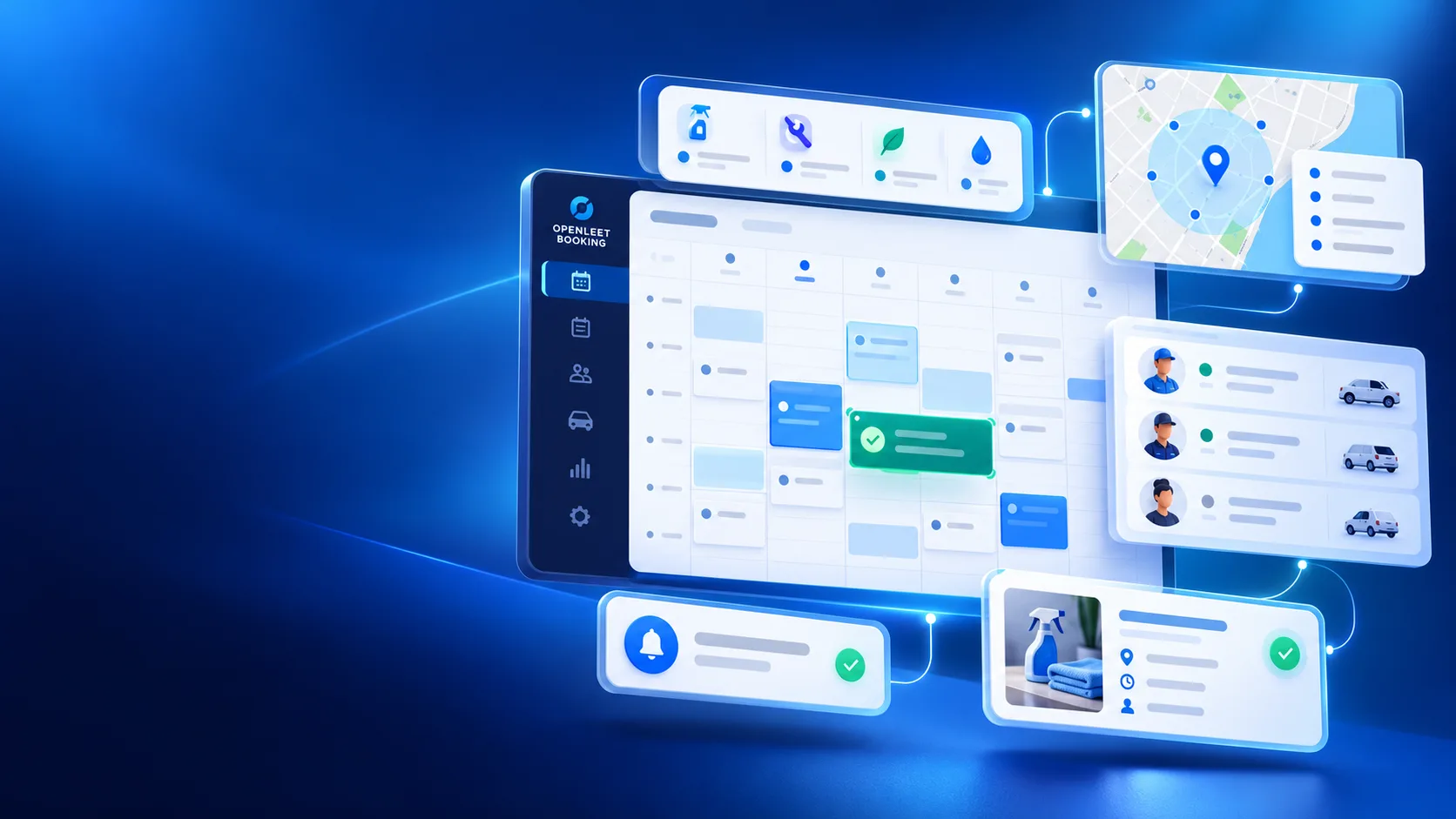
OPENLEET BOOKING: A BOOKING SYSTEM BUILT AROUND HOW SERVICE BUSINESSES ACTUALLY WORK Online booking should be more than a calendar with a few available time slots. For a service business, every appointment is a commitment. The business must provide the right service, at a workable time, in the correct location, with the necessary staff, equipment, and customer information available. Openleet Booking is designed around this reality. It connects services, business hours, staff and resources, service areas, customer questions, appointment communication, and scheduling rules in one system. Customers receive a clear and convenient booking experience, while business owners retain control over when and how appointments are accepted. WHAT IS OPENLEET BOOKING? Openleet Booking is an appointment-management system integrated into the Openleet business platform. Instead of requiring a business to send customers to a separate scheduling product, the booking experience can remain connected to the business’s website, services, contact information, and public presence. A business can use Openleet to: * Define bookable services * Publish accurate availability * Set service durations and scheduling buffers * Manage staff, rooms, vehicles, and other resources * Configure service areas using postal codes * Collect information before an appointment * Automatically or manually confirm requests * Send booking notifications and reminders * Allow customers to cancel or reschedule when permitted * Manage appointments and customer history from the dashboard * Subscribe to a private appointment calendar feed The result is a booking system that reflects how the business actually operates—not merely when its calendar appears empty. A BOOKING JOURNEY CONNECTED TO THE BUSINESS Customers often need context before they are ready to make an appointment. They may want to understand what a service includes, where it is available, how long it takes, and whether it is suitable for their needs. Openleet keeps that information connected. A customer can learn about the business and its services, then move into the booking process without being sent into an unrelated third-party experience. This creates a more consistent journey and helps the customer understand exactly what they are requesting. It also reduces duplication for the business owner. The service being booked is based on information the business has already defined and controls. SERVICE-SPECIFIC SCHEDULING RULES Different services rarely follow identical scheduling rules. A consultation may take 30 minutes, while an installation could require several hours. One service may happen online, another at the business location, and another at the customer’s address. Openleet allows each service to have its own operational settings, including: * Service name and description * Appointment duration * Buffer time before and after the appointment * Maximum simultaneous capacity * Minimum booking notice * Maximum advance-booking period * Location type * Price label * Automatic or manual confirmation * Available days and hours * Eligible staff and resources * Supported service regions * Service-specific customer questions These controls make availability more realistic. Customers are shown times that fit the requirements of the selected service rather than a generic business calendar. LIVE AVAILABILITY BASED ON REAL CONSTRAINTS Openleet calculates availability using the rules configured by the business. The system can consider: * Normal weekly business hours * Service-specific schedules * Appointment duration * Preparation and travel buffers * Existing appointments * Simultaneous capacity * Assigned resources * Scheduled closures * Minimum notice requirements * Advance-booking limits * Service-region schedules * Regional travel rules This helps prevent unavailable or impractical times from being presented to customers. The purpose is not simply to fill a calendar. It is to offer appointment times the business can realistically deliver. OPENING HOURS, CLOSURES, AND SCHEDULE EXCEPTIONS Regular business hours provide the foundation for availability. Business owners can define their timezone, working days, operating hours, and the intervals at which appointment start times appear. Real schedules also include exceptions. Openleet allows businesses to block periods for: * Holidays * Vacations * Training * Staff events * Maintenance * Private commitments * Full-day closures * Partial-day closures These blocked periods prevent new appointments from being scheduled during unavailable times without automatically canceling existing appointments. STAFF AND RESOURCE MANAGEMENT Availability may depend on more than time. A service could require a particular team member, treatment room, vehicle, workstation, or piece of equipment. If that resource is already in use, accepting another appointment may be impossible even when the general calendar appears open. Openleet allows businesses to create and manage resources such as: * Employees * Contractors * Teams * Rooms * Vehicles * Equipment * Specialized work areas Resources can be assigned to the services that require them. Capacity rules help protect those resources from being overbooked. This is especially valuable for businesses where several services share the same limited people or equipment. SERVICE AREAS AND POSTAL-CODE VALIDATION Mobile and on-location businesses face scheduling challenges that ordinary appointment calendars do not address. A cleaner, repair technician, photographer, mobile wellness provider, or home-service company cannot always serve every location at every time. Travel distance and regional schedules affect what is realistically available. Openleet supports service regions that can be defined using: * Postal codes * Postal-code prefixes * Region names * Region-specific days and hours * Travel-buffer time * Services available within each region When required, customers enter their postal code before selecting an appointment. Openleet can then determine whether the address is within the business’s coverage area and show availability appropriate to that region. This helps businesses avoid receiving requests from locations they do not serve. SMARTER ROUTING FOR MOBILE SERVICES Openleet’s regional scheduling can also support businesses that organize work by geographic area. For example, a business may serve one part of a city in the morning and another part in the afternoon. It may dedicate certain days to particular communities or avoid switching repeatedly between distant regions. Regional route rules help the business reserve practical blocks of time and reduce unnecessary travel. The operational benefits can include: * Less travel between appointments * Lower transportation costs * More predictable arrival times * Better use of staff hours * More appointments within the same area * A schedule that is easier to manage This makes Openleet particularly useful for businesses that deliver services at customer locations. A CONFIGURABLE CUSTOMER JOURNEY Not every business needs the same booking form. Openleet allows the booking journey to be configured around the information each business requires. Available steps can include: 1. Service selection 2. Contact information 3. Customer address 4. Date and time 5. Additional questions 6. Review and confirmation Businesses can decide which steps are enabled and which information is required. This keeps simple bookings straightforward while allowing more complex services to collect the necessary details before the business accepts the appointment. CUSTOM BOOKING QUESTIONS The information needed before an appointment varies by business and service. A consultant may need to understand the customer’s goals. A repair company may need the equipment model. A photographer may need the event location and number of participants. Openleet supports general and service-specific questions, including: * Short text * Long-form responses * Numbers * Yes-or-no questions * Single-choice questions * Multiple-choice questions * File requests Questions can include supporting explanations and can be optional or required. Collecting this information during booking reduces follow-up messages and helps the business prepare before the appointment. AUTOMATIC OR MANUAL CONFIRMATION Some appointments can be accepted immediately. Others require review. Openleet supports both workflows. AUTOMATIC CONFIRMATION Automatic confirmation is suitable when the service, availability, and booking rules provide enough information to approve the appointment immediately. This gives customers a fast response and reduces administrative work. MANUAL CONFIRMATION Manual confirmation is useful when the business must review the request, verify details, assign the right person, or confirm that the work is appropriate. The customer submits a request, and the business can then confirm or decline it from the dashboard. Confirmation behavior can be controlled for individual services, allowing one business to use both approaches. APPOINTMENT NOTIFICATIONS AND REMINDERS Clear communication is essential after a customer submits a booking. Openleet supports email notifications for important appointment events, including: * Customer booking receipts * New-booking notifications for the business * Appointment confirmations * Appointment declines * Customer cancellations * Upcoming appointment reminders The system can schedule reminders before an appointment, including 24-hour and 2-hour reminders. These messages can include the business identity, service details, appointment time, reference information, and relevant instructions. This helps customers recognize the business and understand what the appointment is for. CUSTOMER CANCELLATION AND RESCHEDULING Plans change, and customers need a safe way to manage their appointments. When enabled by the business, Openleet can provide secure customer links for cancellation and rescheduling. The business can also define how much notice is required before a customer is allowed to cancel. This provides convenience without giving customers unrestricted access to the business dashboard or appointment data. Business owners remain in control of whether customer cancellation and rescheduling are available. APPOINTMENT AND CUSTOMER MANAGEMENT Openleet provides a central workspace for managing the appointment lifecycle. Businesses can review: * New booking requests * Pending appointments * Confirmed appointments * Declined requests * Customer cancellations * Business cancellations * Completed appointments * No-shows * Customer contact information * Booking answers * Customer and internal notes * Previous appointment history Keeping these details together gives the team useful context before communicating with or serving a customer. It also creates a clearer operational record than managing appointments across disconnected emails, forms, and calendars. PRIVATE CALENDAR SUBSCRIPTION Businesses can subscribe to a private booking calendar feed from supported calendar applications such as Google Calendar, Outlook, and Apple Calendar. This allows Openleet appointments to appear alongside other calendar events the business already follows. The feed is private and designed for calendar visibility. It helps teams monitor upcoming appointments without requiring them to repeatedly check separate systems. DESIGNED FOR MOBILE CUSTOMERS Many customers discover and contact local businesses using their phones. A booking process must therefore be clear, responsive, and easy to complete on a small screen. Openleet’s guided booking journey breaks the process into manageable steps. Customers are not presented with one oversized form containing every possible question. They move through the information in a logical order: * Choose the service * Confirm the service area when necessary * View suitable times * Enter contact or address details * Answer relevant questions * Review the request This reduces confusion and makes complex service bookings easier to complete from a mobile device. THE MAIN STRENGTHS OF OPENLEET BOOKING 1. IT IS CONNECTED TO THE BUSINESS’S REAL INFORMATION Openleet Booking begins with services and operating rules defined by the business owner. It does not invent services, availability, coverage areas, or policies. The business remains the authoritative source of information. 2. IT GOES BEYOND BASIC CALENDAR AVAILABILITY Availability can reflect service duration, buffers, resources, capacity, closures, regional schedules, notice requirements, and existing appointments. This produces more useful appointment options than a simple list of empty calendar times. 3. IT SUPPORTS LOCAL AND MOBILE BUSINESSES Postal-code coverage, service regions, travel buffers, and regional schedules address problems that many general-purpose booking tools overlook. 4. IT REDUCES REPETITIVE COMMUNICATION Customers can provide contact information, addresses, notes, and answers during the booking process. This reduces the need for repeated emails or phone calls before an appointment can be confirmed. 5. IT PRESERVES BUSINESS CONTROL The business decides which services can be booked, when they are available, which questions must be answered, and whether requests are confirmed automatically or reviewed manually. 6. IT CREATES A CONSISTENT CUSTOMER EXPERIENCE The website, business information, services, and booking flow remain connected. Customers are not abruptly transferred to an unfamiliar third-party brand. 7. IT SUPPORTS THE COMPLETE APPOINTMENT LIFECYCLE Openleet helps manage what happens before, during, and after a booking—from the initial request through confirmation, reminders, cancellation, completion, or no-show status. 8. IT IS PART OF A BROADER BUSINESS PRESENCE Booking does not exist in isolation. It can work alongside the business profile, website content, services, contact information, and other information maintained through Openleet. BENEFITS FOR BUSINESS OWNERS A properly configured Openleet Booking system can help a business: * Accept requests outside normal office hours * Reduce appointment-related phone calls * Avoid preventable scheduling conflicts * Collect better information before appointments * Protect staff and resource capacity * Control where mobile services are offered * Organize travel more efficiently * Keep customers informed * Maintain a clearer customer history * Present a more professional booking experience * Spend less time moving information between disconnected tools The greatest benefit is not automation for its own sake. It is giving customers a simpler experience while helping the business make appointments it can confidently deliver. BENEFITS FOR CUSTOMERS Customers benefit from a booking process that answers practical questions before they submit: * Is this the right service? * Does the business serve my location? * When is the service actually available? * What information does the business need? * Has my appointment been received or confirmed? * How can I cancel or reschedule if my plans change? A clear process reduces uncertainty and gives customers confidence that the business has received the correct information. WHO IS OPENLEET BOOKING DESIGNED FOR? Openleet Booking is suitable for many appointment-based businesses, including: * Consultants and professional services * Tutors and instructors * Salons and personal-care providers * Wellness practitioners * Photographers * Cleaning companies * Repair and maintenance businesses * Home-service professionals * Mobile service providers * Teams sharing rooms, vehicles, or equipment * Businesses serving different geographic regions * Businesses that need to review requests before accepting them It is especially valuable when appointment availability depends on more than a single person’s calendar. HONEST INFORMATION REMAINS ESSENTIAL No booking platform can replace accurate business information. To get the best results, business owners should keep their services, durations, hours, closures, resources, coverage areas, questions, and policies current. Openleet provides the structure and tools, but the business supplies the truth. That distinction is important. Customers, search engines, and AI assistants increasingly depend on clear and reliable business information. A successful digital presence should communicate what the business actually offers—not generic claims generated without operational knowledge. A BOOKING SYSTEM GROUNDED IN THE REAL BUSINESS Openleet Booking is designed to connect customer convenience with operational reality. Customers receive an accessible way to choose a service, find a suitable time, provide the right information, and stay informed. Businesses gain control over availability, capacity, resources, service areas, confirmations, and appointment history. The strength of the system is not simply that it accepts bookings. Its strength is that the booking reflects the business behind it.
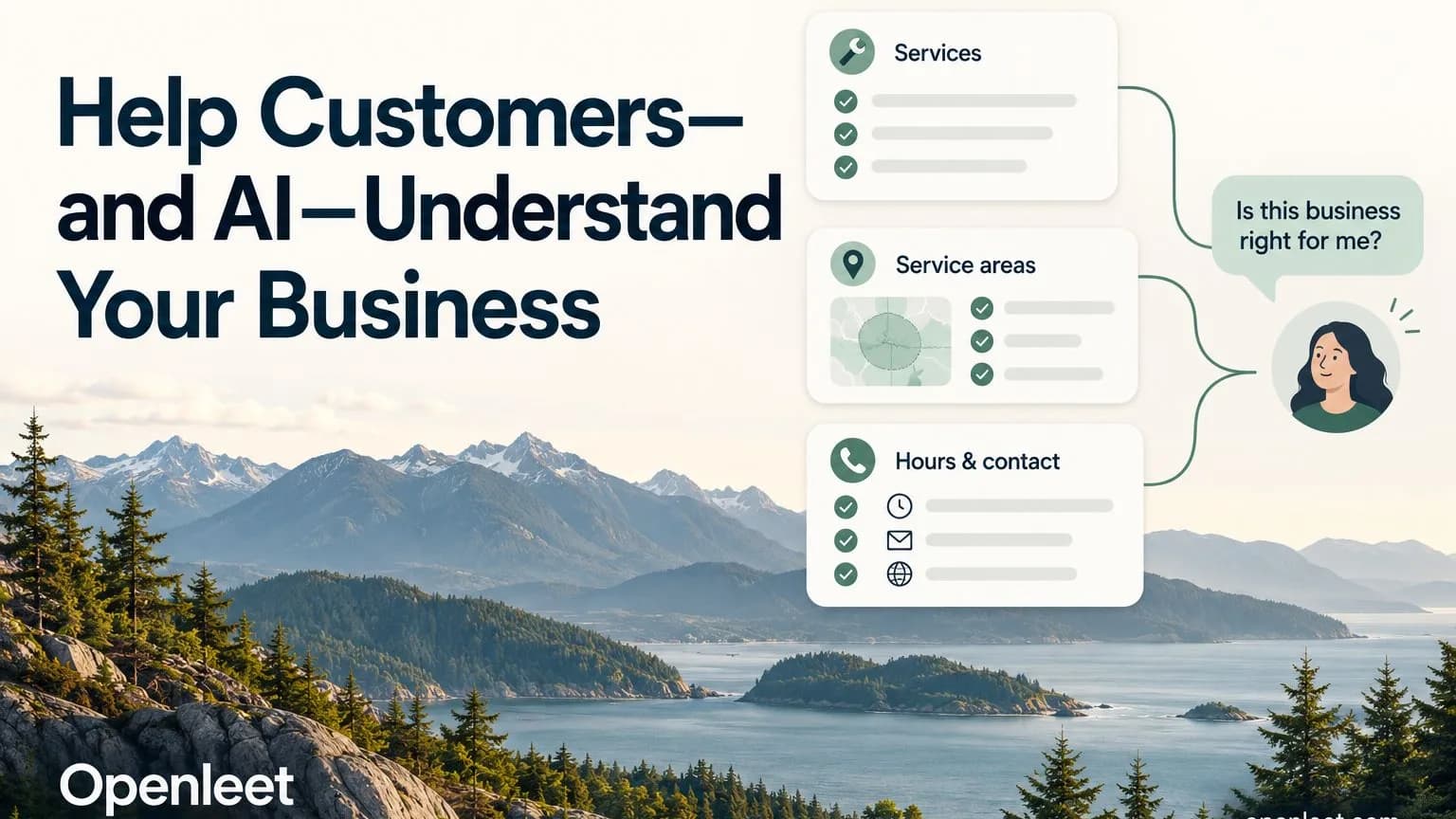
HELP CUSTOMERS—AND AI—UNDERSTAND YOUR BUSINESS You know what your business offers. But does your online presence explain it clearly enough for someone who has never heard of you? Imagine a customer asking an AI assistant: “Who offers move-out cleaning in Squamish, brings their own supplies, and works weekends?” A website that says “professional cleaning services” answers only part of that question. It identifies the type of business, but leaves the customer’s specific needs unanswered. Clear, detailed, and current business information helps close that gap. SPECIFIC QUESTIONS NEED SPECIFIC INFORMATION Customers want to know whether you can help with their particular situation. A homeowner might need a painter who handles exterior wood siding. A parent might want childcare for a particular age group. A small business owner might need an accountant who offers both bookkeeping and payroll. Your business may provide exactly what they need. But if those details are missing online, visitors have to contact you to find out—or continue looking elsewhere. AI-assisted search adds another reason to publish useful answers. Google explains that its AI search features can handle nuanced questions and complex comparisons. Its guidance still emphasizes familiar foundations: helpful content, accessible text, and accurate business information. The practical lesson is straightforward: explain what you actually do in terms your customers understand. USEFUL DETAIL MATTERS MORE THAN EXTRA WORDS Making your information more complete doesn’t mean filling your website with long descriptions or repeating keywords. Compare these two fictional examples: General description: “We provide reliable cleaning services with excellent customer care.” Specific description: “We provide move-out cleaning for apartments and houses in Squamish. Cleaning supplies are included. Weekend appointments are available by arrangement. Contact us with your property size and preferred date for a quote.” The second description answers several practical questions. It helps a visitor decide whether to take the next step. Only publish details that are true for your business. If availability changes frequently, explain how customers can confirm it. SIX AREAS WORTH CHECKING 1. YOUR SERVICES AND WHAT’S INCLUDED Name your services individually and explain their scope. “Landscaping” might include lawn maintenance, garden cleanup, planting, or retaining walls. Customers shouldn’t have to guess which of these you provide. Mention important exclusions where they help prevent misunderstandings. 2. YOUR LOCATION AND SERVICE AREAS Explain where customers can visit you and where you travel to provide services. A North Vancouver address doesn’t automatically tell someone whether you also serve West Vancouver. If you offer remote services throughout BC, make that distinction clear. 3. YOUR HOURS AND AVAILABILITY Keep regular hours accurate and publish relevant changes. Distinguish opening hours from appointment availability. Being open on Saturday doesn’t necessarily mean a customer can book a Saturday appointment. 4. PRICING AND THE QUOTE PROCESS Publish prices when they are appropriate and reasonably stable. For work that needs an individual estimate, explain what affects the price and what information customers should provide. You can make the process clear without promising a fixed price. 5. EVIDENCE THAT HELPS CUSTOMERS ASSESS YOUR BUSINESS Use relevant project photos, genuine testimonials, and accurate qualifications or credentials. Explain what the evidence shows. A photo with a useful description can tell a customer more than a gallery with no context. 6. A CLEAR NEXT STEP Make it easy to call, send an inquiry, request a quote, or book. Test those options on your phone. Check that links work and that messages reach the right person. KEEP YOUR INFORMATION CURRENT AS YOUR BUSINESS CHANGES A website can look professional while describing an earlier version of your business. You may have introduced a service, changed your hours, expanded your service area, or stopped offering something. Those changes should be reflected wherever customers find you. Set a regular reminder to review essential information, and update it whenever a meaningful change happens. Check your website, business profiles, and social accounts for conflicting details. The goal is accuracy. Changing dates or rewriting paragraphs without adding useful information is not a substitute. WHAT CLEAR INFORMATION CAN—AND CANNOT—DO Accurate information gives customers and discovery tools better facts to work with. It does not guarantee search rankings, AI recommendations, or customer inquiries. Google states that no special AI markup or new AI text files are required for its AI search features. Established SEO practices remain relevant, and structured data should match the information visitors can see. Different discovery systems work differently. Clear content is a useful foundation, alongside technical accessibility and the other factors those systems consider. HOW OPENLEET HELPS Openleet starts with your business information. You can organize your details in one dashboard and use them to maintain your public business profile, directory presence, and optional website. The aim is to make it easier to explain your business clearly and keep that information current as your work changes. Built in Squamish, British Columbia, Openleet offers a free business profile to get started. Explore Openleet Try this today: ask someone unfamiliar with your business to look at your online presence. Can they tell what you offer, where you work, and how to contact you? Their unanswered questions are a useful place to start. ---------------------------------------- FURTHER READING Google Search Central: AI features and your website
Visit us, call us, or get directions.
Addresses, hours, and directions for OpenLeet.
39012 Discovery Way, Squamish, BC V8B 0E5, Canada
ABR PLATFORM office in Squamish business park

Hours may vary on holidays and special events. Last updated 2026-06-22. For the latest hours, check Google Maps.
Send a message directly to the business. Your inquiry will be forwarded to their preferred contact channel configured in Openleet.
Send a message, request a quote, or ask a question.