What Information Should Every Small-Business Website Include?
A small-business website should do more than prove that the company exists. It should help a potential customer understand what the business offers, decide whether it fits their needs, trust the information and take the next step.
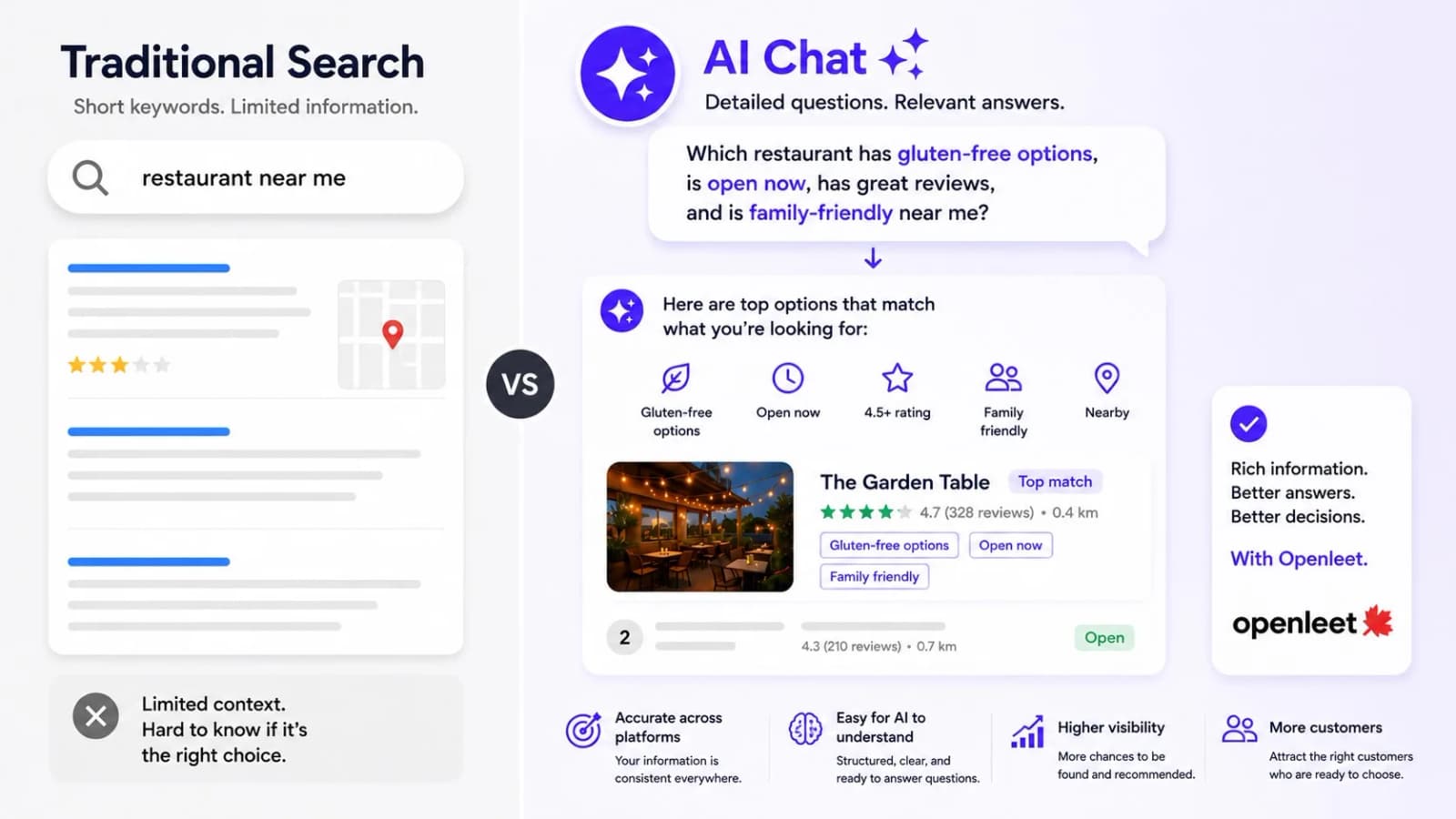
The same information also helps search engines and AI assistants understand when the business may be relevant. If important details are missing, even an attractive website can leave the business difficult to find, compare and choose.
This guide explains what every small-business website should include, which information matters most and how to organize it so that it remains useful to customers, search engines and AI systems.
Start with the questions customers need answered
Before choosing pages, colors or templates, think about the questions a customer asks before making a decision:
What does this business provide?
Is it suitable for someone like me?
Does it serve my location?
Is it open or available when I need it?
What does it cost?
Why should I trust it?
What happens if I contact, book or buy?
How can I take the next step?
A good website answers these questions clearly. It does not make visitors search through vague slogans, image galleries or several unrelated pages to find basic facts.
1. A clear business identity
Every website should immediately identify the business. A visitor should not have to study the entire homepage to determine what the company does.
Include:
The public business name
A recognizable logo or brand mark
The business category
A short, specific introduction
The primary audience or customer type
The main location or service area
A meaningful point of difference
A useful opening statement often follows this structure:
[Business name] provides [products or services] for [customers] in [location].
For example:
North Shore Heating provides residential furnace repair, heat-pump installation and seasonal maintenance for homeowners in North Vancouver and West Vancouver.
This communicates much more than a general slogan such as “Quality You Can Trust.” A slogan can support the identity, but it should not replace a clear explanation.
How Openleet helps: Openleet separates the business name, category, slogan, short introduction, full description, audience and areas of expertise into organized fields. This makes the identity easier to maintain and present consistently across the public profile and machine-readable business information.
2. A useful About section
An About page should help customers understand the people and experience behind the business. It should not be a long corporate history written only to fill space.
Useful information can include:
Why the business was established
Who owns or operates it
The people or communities it serves
Relevant experience and qualifications
Its approach to service
Values that affect the customer experience
What makes it meaningfully different
Specific statements are more credible than broad claims. Instead of saying “We are the best,” explain the experience, process or commitment that supports the claim.
For a family business, the story may be important. For a regulated professional, qualifications may matter more. For a contractor, experience with particular project types may be the strongest evidence.
How Openleet helps: A business can maintain its introduction, story, expertise and identity information in one profile instead of scattering slightly different descriptions across multiple pages. Openleet’s identity guidance can also help identify descriptions that are too broad, unclear or incomplete.
3. Complete information about every important service
One of the most common small-business website problems is a Services page that contains only a short list:
Installation
Repair
Maintenance
Consultation
This tells a customer very little. Every important service should answer:
What is the service?
What problem does it solve?
Who is it designed for?
What is included?
What is not included?
What options or packages are available?
Where is it offered?
How long might it take?
What does it cost, or how is the price calculated?
What should the customer do next?
Important services generally deserve their own pages. A dedicated page gives customers enough information to evaluate the service and gives search engines a clearer subject than a single page containing ten one-sentence offerings.
Avoid creating many nearly identical pages merely to target different keywords or cities. Each service page should contain genuinely useful and specific information.
How Openleet helps: Openleet treats each service as its own information object, with a title, description, price, availability, images, FAQs and other details. The service can have a dedicated public page while remaining connected to the business, location and related information.
4. Products, menus or catalogues
Businesses that sell products should publish more than photographs and product names.
Depending on the product, include:
Product name and category
Clear description
Price and currency
Sizes, variations or options
Availability or stock status
Materials, ingredients or specifications
Dimensions or capacity
Suitable uses or intended customers
Delivery, pickup or shipping information
Return or warranty conditions
Relevant photographs or video
Restaurants should make menus accessible as webpage content whenever possible, not only as a photograph or difficult-to-read PDF. Customers—and many digital systems—need to identify individual items, prices, descriptions and dietary information.
How Openleet helps: Openleet provides structured content for products, menu items, offers and related media. This allows a business to update individual items without redesigning an entire page and gives each offering clearer meaning than an unstructured image or text block.
5. Prices and the purchasing process
Customers frequently want pricing information before they make contact. Not every business can publish an exact price, but almost every business can reduce uncertainty.
Depending on the service, publish:
An exact price
A starting price
A typical price range
An hourly, daily or unit rate
Package options
Minimum charges
Factors that affect the final cost
Deposits, taxes or additional fees
Accepted payment methods
How estimates or consultations work
If an exact price is impossible, explain why and describe what is required to prepare an estimate. “Contact us for pricing” gives the customer no idea what will happen next.
Pricing transparency can also save the business time by reducing inquiries from customers whose needs or budgets do not match the service.
How Openleet helps: Products and services in Openleet can include price, currency, unit, offers and availability details. Businesses can update these details without searching through multiple website pages whenever a price changes.
6. Location and service-area information
Customers need to know where the business operates and whether it can serve them.
For a customer-facing location, include:
Full address
Map and directions
Building, unit or entrance instructions
Parking or transit information
Accessibility information
Telephone number for that location
Location-specific hours
For a service-area business, identify the cities, communities or regions actually served. A statement such as “Serving British Columbia” may be too broad to help a customer understand whether the business works in their neighbourhood.
Also clarify whether the service is:
On-site
At the business location
Mobile
Remote or online
Available for pickup or delivery
How Openleet helps: Openleet can connect a business with one or more locations, addresses, contact details, hours and service areas. This is particularly helpful when different branches have different hours or when a service is available only in certain locations.
7. Accurate hours and current availability
Incorrect hours create frustration and quickly damage trust. Publish:
Regular opening hours
Appointment or service hours, if different
Holiday and special hours
Seasonal schedules
Emergency or after-hours availability
Expected response times
Typical lead times
Appointment, enrolment or product availability when appropriate
If availability changes frequently, the website should make it clear when the information was updated and how customers can confirm it.
How Openleet helps: Business owners can manage regular and special hours as organized information. This reduces the risk of hours being buried inside an old page or image and makes them easier to update and reuse across the business profile.
8. Contact information and a clear next action
Do not assume every visitor knows what to do after reading the website. Each important page should offer a relevant next step.
Contact options may include:
Telephone number
Business email address
Contact form
Appointment or reservation link
Quote-request form
Store directions
Ordering instructions
Active messaging channels
Expected response time
The appropriate action depends on the page. A service page may invite the customer to request an estimate. A restaurant page may offer directions, ordering or reservations. A childcare page may explain how to arrange a tour or join a wait-list.
Forms should request only the information required for the next step. Long or confusing forms can discourage otherwise interested customers.
How Openleet helps: Openleet connects contact methods and calls to action with the business profile and its content. This allows customers to move from learning about a service to calling, requesting information, visiting or booking without searching for contact details elsewhere.
9. Trust signals and qualifications
Customers look for evidence before trusting an unfamiliar business. The appropriate signals depend on the industry, but they may include:
Licences
Certifications
Insurance
Professional association memberships
Team qualifications
Years of relevant experience
Guarantees or warranties
Awards
Verified contact information
Safety or security practices
Completed projects
Media coverage
Trust signals should be specific, current and verifiable. A badge without its name or context provides limited value. If a qualification expires, the business should have a process for reviewing it.
Never claim a licence, certification or membership that cannot be substantiated.
How Openleet helps: Businesses can present identity details, qualifications, project evidence, media and related trust information alongside their services. Keeping these elements connected helps customers understand why a claim is relevant instead of seeing a disconnected row of logos.
10. Reviews and testimonials
Social proof can answer a question the business cannot answer by itself: what was it like to be a customer?
A review and a testimonial are related but different:
A review is generally submitted independently and may include a rating.
A testimonial is supplied or selected for promotional use by the business.
A useful testimonial may include:
The customer’s name, with permission
Their role or company, when relevant
The particular service or product used
A specific experience or result
The original date
The source and a link to the original, when available
“Excellent company!” is positive but not very informative. A detailed account of the problem, service and outcome provides stronger evidence.
Businesses should not fabricate testimonials or present edited wording as an exact customer quotation.
How Openleet helps: Openleet keeps testimonials separate from independent reviews. A business can record the customer, source, original date, supporting media and publication status, allowing social proof to be presented with more context and transparency.
11. Useful photographs and videos
Images should do more than decorate a page. They can provide evidence and answer practical questions.
Useful visual content includes:
The storefront or entrance
Team members
Products and menu items
Facilities and equipment
Completed work
Before-and-after results
The service process
Events or activities
Relevant certificates
Use authentic images whenever possible. Stock photographs may support a design, but they rarely prove what a particular business provides.
Add meaningful alternative text and captions when they help explain the image. Do not place essential information only inside an image because customers using assistive technology—and some digital systems—may not receive it reliably.
How Openleet helps: Openleet allows images and galleries to be attached to the business and its services, products, articles and other content. This preserves the relationship between an image and what it demonstrates instead of storing every picture in one disconnected gallery.
12. Frequently asked questions
An FAQ section should answer genuine customer questions, not repeat marketing claims in question form.
Good questions often concern:
Suitability or eligibility
Price
Service area
Preparation
Timing
Availability
What is included
What happens after booking
Cancellation or refund rules
Warranties
Safety or accessibility
Ask employees which questions they answer repeatedly. Review inquiry emails, phone calls and customer conversations. Those questions are often more valuable than ones invented solely for SEO.
Clear answers can reduce repetitive inquiries and help customers move forward with more confidence. They also give search engines and AI systems explicit answers to common questions about the business.
How Openleet helps: FAQs can be connected to the overall business or to a particular service, product or page. This keeps answers close to the subject they explain and makes them easier to update when the policy or offering changes.
13. Policies and customer expectations
Clear policies help customers understand what will happen before and after a transaction. Depending on the business, publish:
Cancellation and rescheduling rules
Refunds and returns
Deposits
Shipping and delivery
Warranties
Appointment procedures
Safety requirements
Age or eligibility restrictions
Privacy practices
Terms of service
Write policies in plain language. Customers should be able to understand the practical effect without interpreting legal terminology.
Legal requirements vary by jurisdiction and industry, so businesses should obtain appropriate professional advice where necessary.
How Openleet helps: Openleet can place relevant policy information near the business, service or offer it governs. This helps prevent important conditions from being hidden in an unrelated page and makes routine updates easier to manage.
14. Projects, case studies and evidence of work
Customers often trust evidence more than claims. Show what the business has done through:
Project portfolios
Case studies
Before-and-after examples
Completed installations
Customer outcomes
Product demonstrations
Sample menus or work
Relevant galleries
A useful case study explains:
The customer’s problem or goal
The work performed
Important decisions or challenges
The result
The service connected with the project
Avoid publishing confidential customer information without permission.
How Openleet helps: Businesses can publish articles, galleries and other content connected to the relevant service or business identity. This turns completed work into organized, searchable evidence instead of leaving it only in a social-media feed.
15. Timely updates
Some business information changes too frequently to belong permanently on the homepage. A website may need to communicate:
New services or products
Seasonal availability
Events
Temporary closures
Promotions
New employees
Completed projects
Important operational changes
Publish updates only when the business can maintain them. An abandoned News page whose newest item is several years old may make the entire website feel neglected.
How Openleet helps: Openleet supports different content types such as articles, events, products, services and galleries. Owners can publish the appropriate kind of update and connect it to the business information it affects.
16. Privacy, terms and required disclosures
Most business websites collect at least some visitor information through contact forms, analytics, booking tools or cookies. Depending on the business and jurisdiction, the website may need:
A privacy policy
Terms and conditions
Cookie information or consent controls
Refund and cancellation terms
Copyright information
Regulatory disclosures
Consent language for forms and marketing
These documents should reflect what the website and business actually do. Copying another company’s policy can introduce inaccurate statements and legal risk.
This checklist is practical guidance, not legal advice. Requirements vary, so consult a qualified professional when necessary.
17. Structured data and machine-readable meaning
Customers need visible, readable content. Search engines also benefit from structured data that identifies what the content represents.
Structured data may describe:
The business and its type
Locations and addresses
Opening hours
Services
Products and offers
Prices and currencies
Events
Articles
Reviews and ratings
Images
Google explains that structured data provides explicit clues about the meaning of a page. It can help eligible content appear with enhanced search features, but it does not guarantee a special result or higher ranking. See Google’s introduction to structured data.
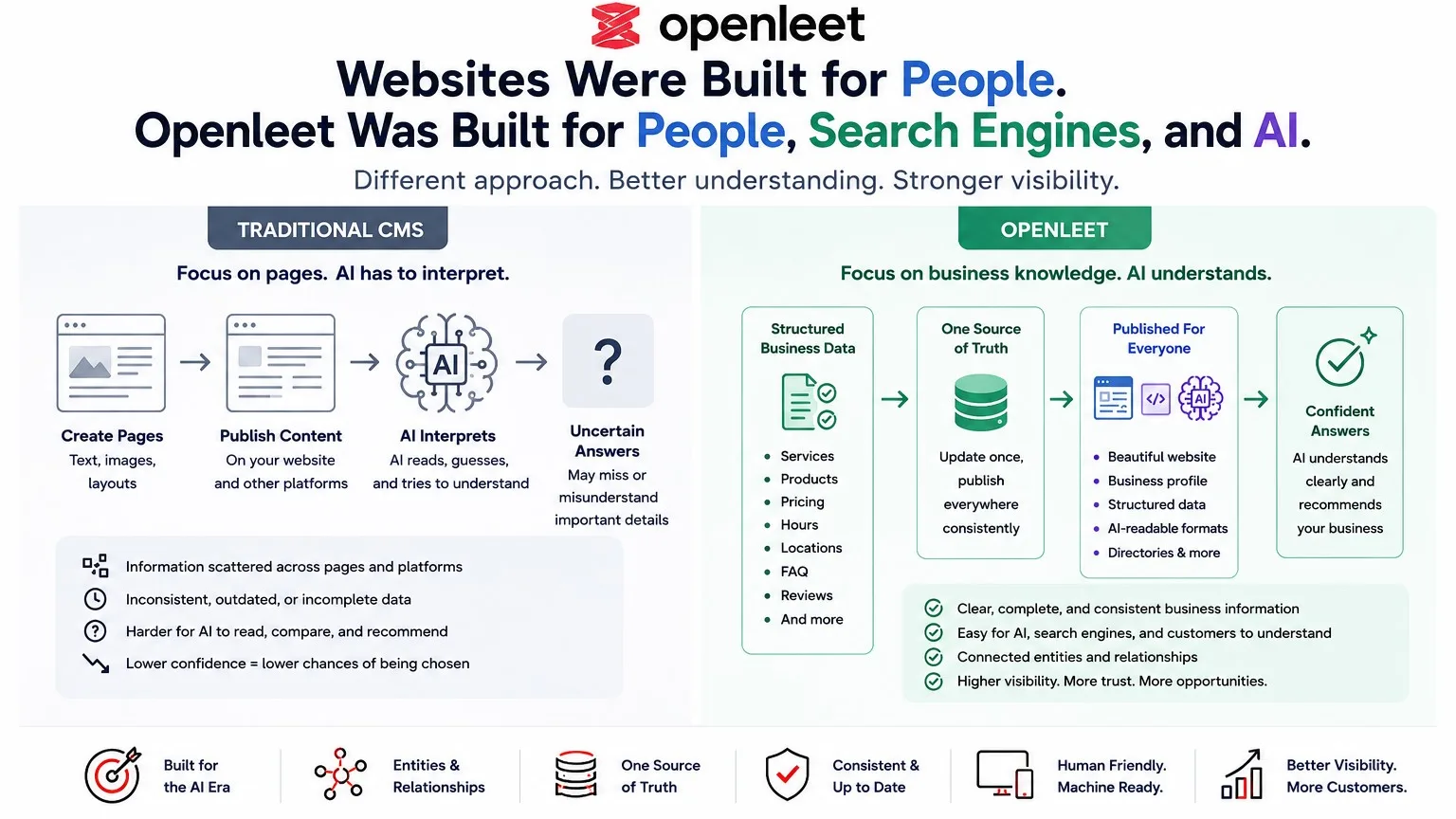
Machine-readable information is also increasingly relevant as crawlers and AI systems interpret business websites. However, structured data, llms.txt or any other technical format cannot guarantee that an AI assistant will cite or recommend a business. The information must first be accurate, useful and publicly accessible.
How Openleet helps: Openleet starts with structured business entities rather than adding markup after a page has been designed. It can present connected information about the business, locations, services, products and content in human-readable pages and appropriate machine-readable formats.
18. Consistent information across the web
A business website does not exist in isolation. Customers may also encounter the company through:
Google Business Profile
Openleet
Social-media accounts
Industry directories
Association profiles
Booking or delivery platforms
Government and professional records
Core facts should agree across these sources, especially:
Business name
Address
Telephone number
Website address
Hours
Category
Service descriptions
Inconsistent information creates uncertainty for customers and makes it harder for digital systems to determine which details are current.
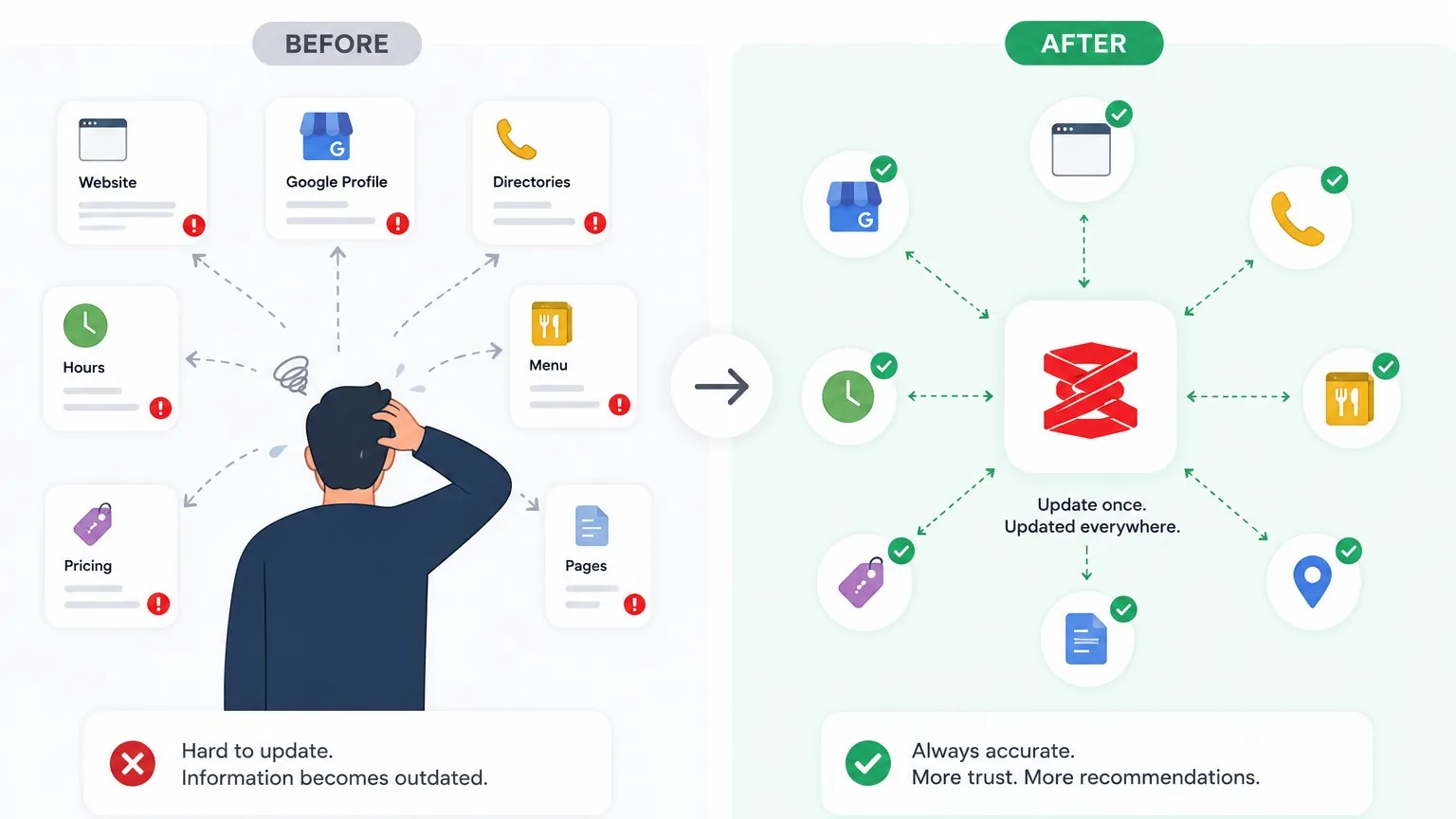
How Openleet helps: Openleet provides an owner-controlled source where a business can organize its current information. It does not automatically correct every external platform, but it gives the owner a clear reference when reviewing and updating other profiles.
19. Ownership and an update process
A business website is not finished when it launches. Information changes:
Hours change for holidays.
Prices and packages evolve.
Employees join or leave.
Services are added or discontinued.
Qualifications expire or renew.
Locations and contact methods change.
Every business should decide:
Who is responsible for updates?
Which information should be checked monthly, quarterly or annually?
Can the owner make routine changes without a developer?
How will outdated information be identified?
Are updates reflected everywhere the information appears?
A simpler website that the owner can keep accurate is often more useful than an elaborate website that becomes outdated because every change requires technical assistance.
How Openleet helps: Openleet gives authorized business owners a dashboard for maintaining their identity, locations, contact details, hours, offerings and content. Organized fields and update guidance make routine maintenance more manageable than editing the same fact in multiple page layouts.
What information is essential?
Not every business requires every feature. Use this priority framework:
Priority Information to include
Essential: Identity, offerings, location or service area, hours, contact details and next action
Decision-supporting: Prices, availability, FAQs, policies and purchasing or booking process
Trust-building: About information, qualifications, team, testimonials, reviews and evidence of work
Discovery-supporting: Dedicated service pages, useful articles, structured data, descriptive media and consistent information
Industry-specific: Menus, inventory, delivery, enrollment, eligibility, warranties or safety procedures
Begin with the essential information. Complete it accurately before adding features that look impressive but do not answer customer questions.
Industry-specific website information
Different businesses require different details:
Business type Information that especially matters
Restaurant: Menu, prices, dietary options, hours, location, reservations, pickup and delivery.
Contractor: Services, service area, license, insurance, projects, estimate process and warranty.
Childcare provider: Age groups, hours, availability, licensing, safety, program details and enrollment process.
Accountant Specialties, client types, qualifications, deadlines, document requirements and consultation process,
Retail store: Products, stock or availability, prices, location, returns, pickup and delivery.
Consultant: Expertise, audience, process, expected outcomes, packages, case studies and booking.
Tourism business: Dates, availability, inclusions, restrictions, meeting location and cancellation policy.
Healthcare or wellness provider: Qualifications, services, suitability, booking, preparation, accessibility and applicable policies.
The goal is not to publish the greatest possible amount of information. It is to publish the information a customer needs to make a confident decision.
A practical website-information checklist
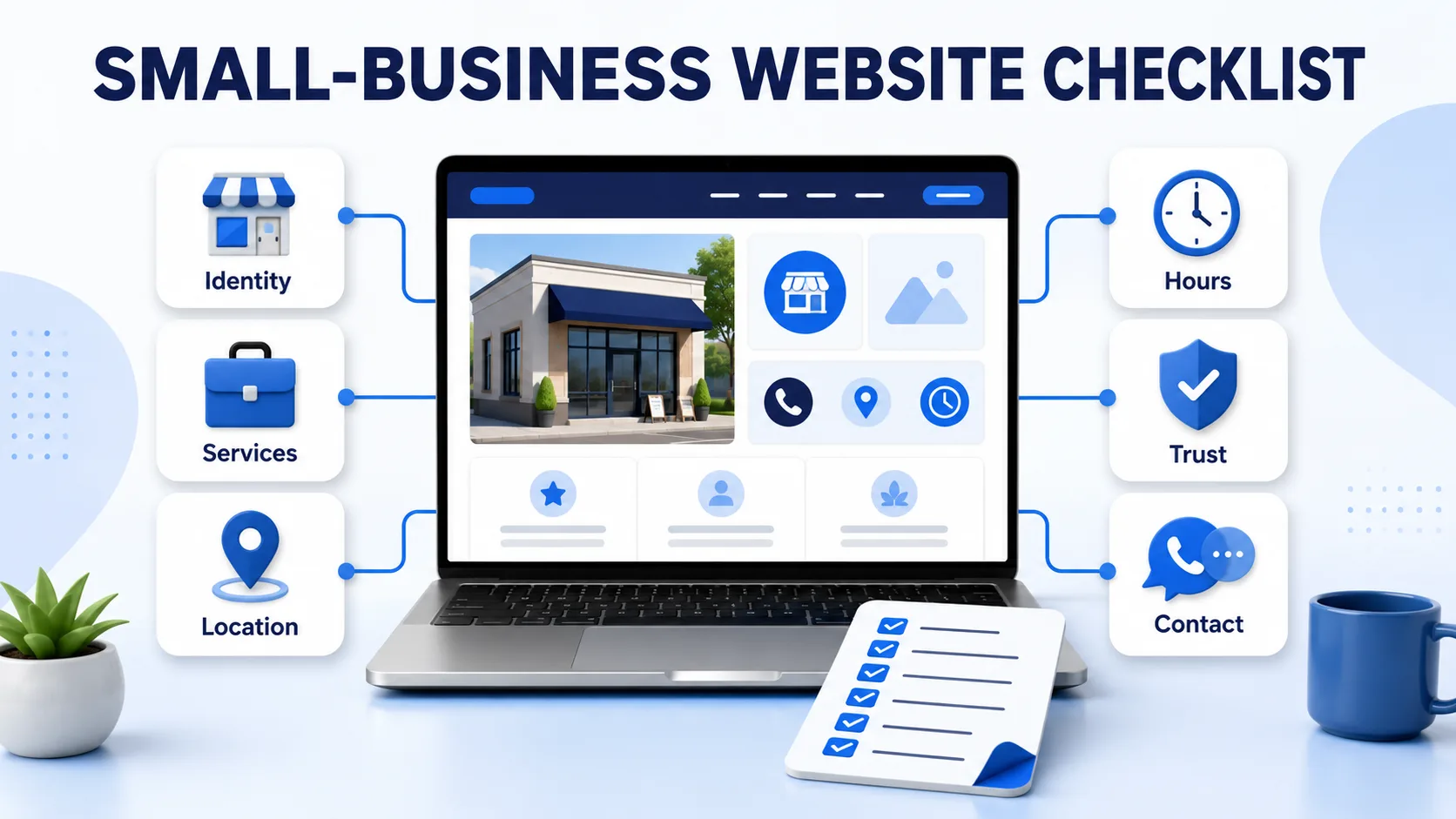
Before launching or updating a small-business website, confirm that a customer can find:
A clear explanation of what the business does
The customers and locations it serves
Complete descriptions of important services or products
Prices, ranges or an explanation of the estimate process
Accurate address, service area and hours
Telephone, email and relevant next actions
Qualifications and verifiable trust signals
Useful reviews or testimonials
Authentic photographs or evidence of work
Answers to common customer questions
Important policies and expectations
Privacy and legally required information
Consistent information across the website and other profiles
A practical process for keeping everything current
Appropriate structured data for important content
A website should be an understandable source of business information
The best small-business website is not necessarily the one with the most pages. It is the one that provides the right information, presents it clearly and keeps it accurate.
Start with the facts customers need before they call, visit, book or buy. Organize those facts so people can find them quickly. Then make their meaning accessible to search engines and AI systems without sacrificing clarity for human visitors.
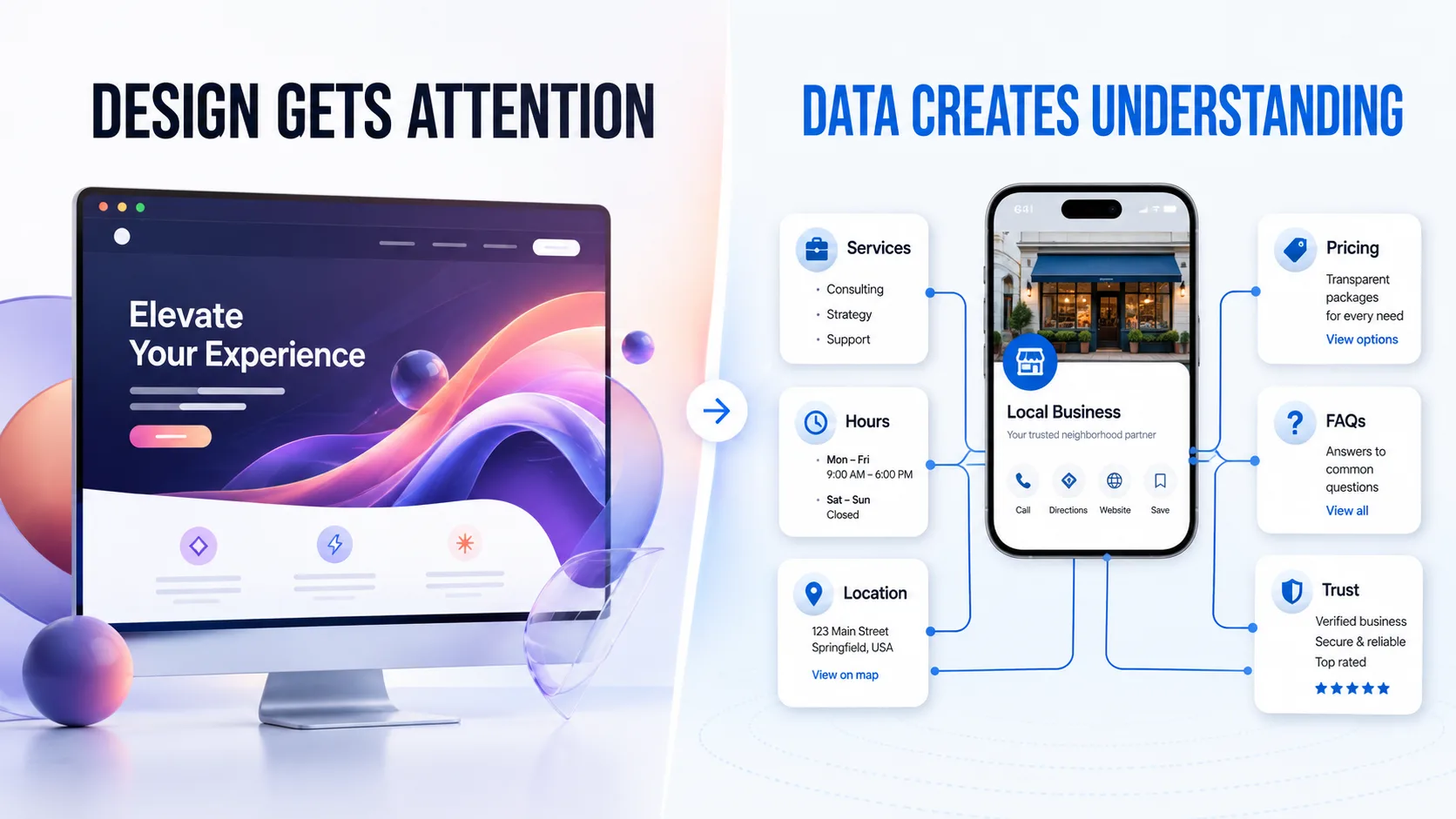
Design can make information attractive and easy to use. But the information is what allows the business to be understood, compared, trusted and chosen.
Organize your business information with Openleet
Openleet helps small-business owners manage their identity, locations, hours, services, products, pricing, FAQs, testimonials, galleries and other important information from one dashboard.
That information can be presented through a public business profile, dedicated content pages, structured data and machine-readable resources—without requiring the owner to manually design every page or call a developer for every routine update.
Openleet does not guarantee search rankings or AI recommendations. It helps give customers, search engines and AI systems clearer, more complete and more current information from which to understand the business.
Can AI confidently understand your business?
Use the free Openleet AI Business Visibility Check to discover what AI can identify about your company, which important facts may be missing and what customer questions your online presence may leave unanswered.